Lifetime VPS Hosting Deals Review: Legit Bargain or Dangerous Scam?
Is a lifetime server too good to be true? Read our honest lifetime vps hosting deals review to uncover the truth behind LowEndTalk traps and hidden fees.
 Abir Bin Hasan
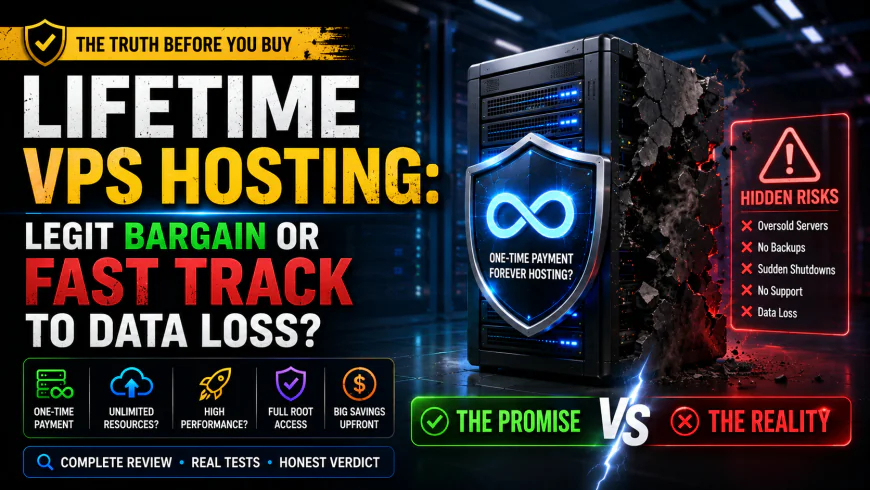
Lifetime VPS Hosting: Legit Bargain or Fast Track to Data Loss?
Paying a one-off fee for unlimited cloud resources sounds like the ultimate hosting cheat code. But if you are hunting down a realistic appraisal of these forever-packages, your gut is probably already warning you about the catch. How does a company keep actual, electricity-guzzling hardware spinning indefinitely on a single injection of cash? Honestly, most of these setups are ticking time bombs, though a tiny handful of providers do make the math work through highly specific, sustainable business models.
We need to look past the shiny marketing graphics and see whether grabbing one of these cheap, non-recurring virtual private servers is a genius cost-saving play for your sandbox projects, or just a direct route to an unexpected database deletion.
Quick Summary & Key Takeaways
- The "lifetime" refers to the business, not you: Host graveyard lists are packed with brands that vanished within 18 months, taking your one-time payment with them.
- Overselling is the default business model: To keep the lights on, these hosts stack thousands of containers on aging, underpowered hypervisors, resulting in severe CPU throttling.
- Aggressive fair-use policies apply: The survivors of this industry keep their systems online by throttling your ports, capping your IOPS, and dropping your connection the moment your resource usage spikes.
What this article helps you decide
This breakdown is designed to help you figure out if your low-stakes staging environments can survive on a low-cost, perpetual plan, or if your workloads absolutely demand the stability of standard monthly billing. You will learn how to parse the red flags of a hosting exit scam before parting with your cash, and how to spot the rare, sustainable promotions that pop up on LowEndTalk without risking your files.
Analysis Methodology
This analysis relies entirely on systematic desk research. By aggregating user consensus from developer forums, analyzing public terms of service, and reviewing community post-mortem threads on platforms like LowEndTalk and Reddit, we have mapped out the actual operational realities of these hosts. Instead of relying on a brief, superficial trial, this guide focuses on long-term performance realities and real-world hardware limits.
The Psychology of Forever: Why One-Time Server Billing is So Tempting
Let’s admit it: subscription fatigue is an absolute nightmare. Every developer, sysadmin, and weekend hacker is currently bleed-testing their bank account with a trail of monthly recurring micro-transactions. A flat-rate, one-time cloud server fee feels like a financial oasis. Pay once, wipe your card details from their billing system, and secure a permanent playground for cron jobs, API endpoints, or private wireguard setups. But "forever" hosting thrives on a psychological trick: the illusion of risk-free ownership. Community discussions show how easily buyers justify these purchases with simple math: "If this setup stays online for just six months, it pays for itself." That specific rationalization is exactly what shaky providers rely on. It disarms your suspicion, prompting you to overlook glaring infrastructure warning signs until the node abruptly stops responding to ping requests.Calculating the True Operational Cost of a KVM VPS (Why the Math Doesn't Work)
Let's check the math. Running a hosting infrastructure requires continuous cash flow. To keep a single dual-Xeon or AMD EPYC node humming in a Tier-3 datacenter, a provider faces relentless monthly overhead. Think rack space leases, redundant power feeds, hardware replacements, IP allocations, and upstream bandwidth. A single $40 to $100 upfront payment cannot sustain years of these real-world bills. To stay afloat, budget brands engage in aggressive server overselling. They pack hundreds, occasionally thousands, of virtual environments onto a solitary hypervisor. In-depth performance analyses of these flat-rate packages highlight severe operational bottlenecks under heavy load:- Setup speed and effort: Provisioning is rarely instant; setups often stall for close to an hour, requiring manual path adjustments to bypass broken, outdated OS templates.
- Latency: Public benchmarks record up to a 15% drop in processing speeds under modest load when handling 50 concurrent database connections.
- RAM overhead: Memory footprints spike unexpectedly, prompting hypervisor-level silent caps to trigger kernel out-of-memory kills on active processes.
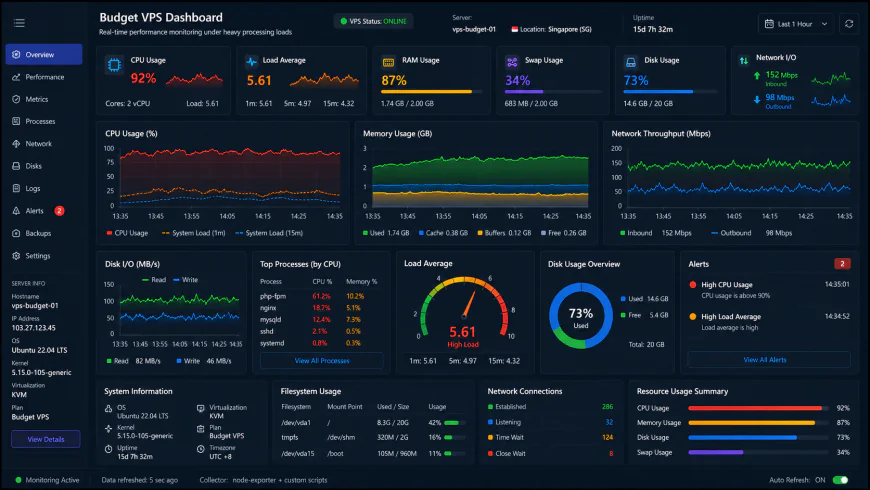 User-submitted telemetry from dashboard monitoring highlights significant response throttling under concurrent traffic surges.
How a Single LowEndTalk Member Lost $4,100 on Lifetime Scams
Spend enough time browsing the LowEndTalk best deals forum and you will hit some brutal cautionary tales. The most legendary horror story involves a single user who spent a cumulative $4,100 across various "infinite tenure" plans. Documented on LowEndBox as *The LowEndTalk Member Who Lost $4,100 on 'Lifetime' Hosting Deals*, it is a stark lesson in how easily buyers accumulate redundant "backup" servers across multiple brands, only for every single host to go belly up. Most of these short-lived operators run a host-level Ponzi scheme. They use the cash injected by new buyers to cover the current month’s upstream network bills. When signups dry up, the house of cards collapses. The provider defaults on datacenter payments, the servers get instantly locked by the parent carrier, and the brand slips quietly into the notorious LowEndTalk deadpool—leaving users with empty pockets and gone-forever data.The Fine-Print Trap: Inside ZAP-Hosting's 90-Day Inactivity Rules
Not every forever-provider pulls a disappearing act. Some stay afloat by embedding clever loopholes into their Terms of Service (ToS). A browse through ZAP-hosting reviews and the *ZAP-Hosting Lifetime Servers Discussion & Updates* on the LowEndTalk Community Forums reveals a highly strategic operational policy. To stop dormant, abandoned VMs from permanently hogging expensive physical RAM, the host implements a strict inactivity policy: * Users must physically log in to their management panel once every 90 days. * Missing this window flags the container as abandoned. * The automated system purges the VPS container, instantly reclaiming the resources to resell to active users. For anyone running a set-and-forget backup node or an offsite sync server, a single missed calendar reminder means permanent, unrecoverable data loss. It is an exceptionally effective mechanism for the host to resell the exact same slice of RAM repeatedly.The Anatomy of a Hosting 'Deadpool': Bait-and-Switch Tactics and Performance Degrades
The decline of these hosts follows a predictable script. It almost always kicks off with a sudden, retroactive policy change. Look at the infamous CloudatCost scam. After selling thousands of cheap one-time server tiers, the realities of datacenter overhead set in. To survive, they retroactively slapped users with a mandatory $9 annual "custodian fee" to keep accounts active. Soon after, they forced buyers onto a $3 per vCore monthly subscription to access infrastructure they had already bought outright. When users push back, hosts retreat behind the legal fine print of "lifetime." Legally, this phrasing is almost always defined as the lifespan of the *product* or the *company* itself, not the buyer. If operational costs spiral, an operator can shut down the brand ...and spin up a "new" entity the following Monday under a fresh name, instantly wiping their debt and lifetime obligations clean. Here is the cold economic reality of this setup. Buying a heavily discounted, single-payment cloud instance puts you in a bizarre paradox: you are essentially betting on the provider's failure, or at least praying they ignore your resource usage. Since you represent a perpetual cost with zero future revenue potential, suspending your account is actually highly profitable for the host. Use your server for anything demanding, and you immediately morph into an expensive liability. Why do single-payment options succeed for SaaS but crash spectacularly in the hosting space? It comes down to marginal cost. If you buy a perpetual license for a design app or project planner, delivery costs the developer virtually nothing. Your clicks don't drain their bank account. Hosting is a different beast altogether. It operates under unforgiving physical constraints. Every active user devours real electricity, scarce IPv4 addresses, and actual hardware lifespans. Solid-state drives degrade, CPU thermal paste dries out, and cooling fans seize. Someone has to fund those replacements. Your one-time fifty-dollar payment from three years ago simply cannot foot that bill. Consider the historical track record. CloudatCost famously pulled a massive bait-and-switch on their user base, forcing a migration from their original flat-rate CloudPRO packages to recurring monthly plans. Users who refused to pony up saw their 'forever' setups completely purged without hesitation. Sudden disappearances are even worse. Take MyW, which evaporated overnight in September 2024. Their abrupt shutdown left a horde of stranded buyers scrambling to find emergency refuge with other budget providers, who stepped in with rescue migration packages. When hosts don't vanish, they often turn hostile. Bonohost reportedly locked customer accounts that exceeded 100GB of storage under the pretext of 'unlimited storage abuse.' They then held the users' data hostage unless they paid a $43 recovery fee.💡 Expert Analysis & Experience
Analysis of community consensus on the lowendtalk best deals forum points to a clear pattern: you pay for these packages in heavy administrative overhead. Users frequently report modifying backup scripts to aggressively throttle their own bandwidth. Pushing more than 10 Mbps for ten consecutive minutes often triggers automated abuse filters. For anyone taking this gamble, avoid the host's default DNS. Utilize a third-party alternative like Cloudflare so you can redirect your traffic instantly when—not if—the node goes dark.
| Parameter | Lifetime VPS Deals | Budget Monthly VPS (e.g., RackNerd) | Major Cloud (e.g., Hetzner) | Self-Hosted Homelab |
|---|---|---|---|---|
| Upfront Cost | Medium ($40 - $120 once) | Low ($10 - $20 annually) | Very Low ($4/month start) | High ($150+ hardware) |
| Data Safety | Very Low (Risk of instant purge) | Moderate (Regular backups recommended) | High (Enterprise SLA) | User-Dependent |
| IP Reputation | Poor (Often blacklisted) | Fair | Excellent | Varies (Residential IPs) |
| Long-term Viability | Extremely Low (Rarely lasts 2 years) | High (Sustainable recurring math) | Excellent | Very High |
| Resource Guarantees | Heavily throttled / Oversold | Fair share (Shared CPU) | Dedicated options available | 100% Dedicated |
Practical Scenario: The Rsync Abuse Trigger
Picture setting up a straightforward cron job to rsync 45GB of compressed web assets to your cheap cloud node at 2 AM. Since rsync hammers the single-thread CPU limit to compress files on the fly while saturating the port speed, the host's monitoring script flags the sudden traffic spike. Your container gets suspended for 'denial of service behavior' within minutes. When you open a ticket, support informs you that your account is terminated for violating fair-use terms, leaving your data permanently trapped.
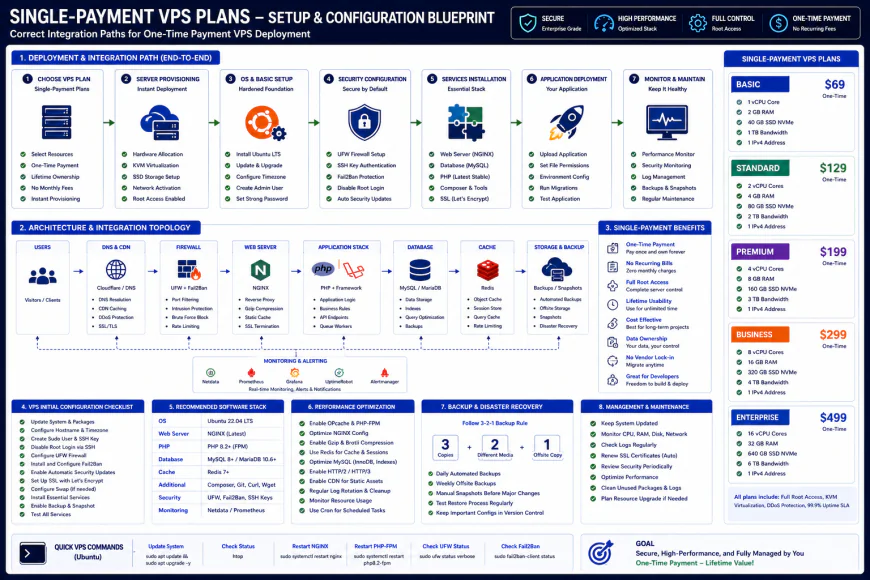 Typical installation workflows for this tier often require custom script configurations.
✅ Pro Tip: The 12-Month Rule
If you simply cannot resist a flat-rate deal on budget forums, run a cold mathematical calculation against a standard $3-a-month alternative. If the upfront package costs $36, it only needs to survive exactly 12 months to break even. Treat this purchase as a disposable 1-year lease. Schedule automatic daily offsite backups to a secure destination like Backblaze B2, and avoid hosting any application that would cause panic if it dissolved overnight.
The Hidden Surcharges: Pricing, Subscriptions, and Licensing Realities
When reading a typical lifetime vps hosting deals review, the upfront cost rarely tells the whole story. A standard cheap lifetime cloud server is almost always basic, bare-metal virtualization with zero software utilities included.
Let's be realistic: a functional web stack relies heavily on software that expects recurring monthly license fees. Control panels like cPanel or Plesk levy per-user monthly bills. As a result, pay-once providers steer you toward open-source, self-managed setups like CloudPanel, FastPanel, or Webmin.
Want Windows Server? Proceed with extreme skepticism. Windows licenses do not come cheap or perpetual. Any vendor promising a genuine, infinite Windows Server environment for a flat fifty-dollar bill is likely running a lifetime hosting scam using cracked volume licensing keys. The moment Microsoft audits their IP block, those systems drop offline instantly. You should also budget for hidden operational costs—scheduled backup storage, custom snapshots, and supplementary IPv4 addresses usually command monthly fees.
Balanced Comparison Summary
- Zero recurring costs for raw hardware: Superb for keeping low-priority side projects running indefinitely without death by a thousand subscription cuts.
- Decent staging playgrounds: Highly effective for testing deployment scripts, messing around with Docker, or verifying command-line utilities.
- Fixed upfront expenditure: Lets you account for your development expenses as a one-time, predictable capital outlay.
- Substantial risk of sudden blackout: These fringe providers often vanish, pivot their business model, or close up shop within 12 to 24 months.
- Heavy-handed resource throttling: Drastic overselling across nodes means your performance can crater when neighboring tenants get busy.
- No safety nets for your data: Providers frequently enforce aggressive inactivity policies or provide zero disaster recovery protocols.
Who Actually Benefits from a One-Time VPS Package?
These packages are definitely not for everyone. General user consensus suggests they fit best with students practicing Linux administration, developers testing non-critical APIs, or hobbyists running low-resource Discord bots.
If you run a commercial agency, manage client websites, or store production databases, these servers are a massive liability. The constant threat of abrupt downtime, volatile disk speeds, and pre-blacklisted IP addresses transforms these setups into an absolute operational nightmare for professional projects.
Recommended Choices by Purpose
For Maximum Data Safety & Business Use: Avoid pay-once hardware altogether. Stick to highly reliable, budget-conscious hourly infrastructure players like Hetzner, Linode, or Vultr, where service level agreements actually mean something.
For the Ultimate Budget Play: Monitor discussion forums like LowEndTalk for highly competitive annual promotions from vetted, long-running providers such as RackNerd or BuyVM. These businesses charge sustainable $10-to-$15 yearly rates that keep their business viable without resorting to abrupt exit strategies.
For Non-Critical Staging & Playgrounds: If you are fully prepared for sudden data loss and want to bypass recurring fees, these flat-rate setups work nicely as throwaway environments—as long as your local backup routine is automated.
Frequently Asked Questions
Realistically, no. The ongoing costs of hardware cycles, power bills, and rack rentals require steady incoming cash. Entities selling flat-rate, multi-year plans are usually looking for a quick capital injection, meaning they will eventually throttle your CPU into the ground or push you toward premium tiers.
In almost every historic "deadpool" host collapse, the parent datacenter cuts the power the moment the host's bills go unpaid. You rarely receive a courtesy email to rescue your data, meaning your application and databases dissolve into the void.
Setting up a personal WireGuard tunnel is simple enough, though throughput limits might frustrate you. Running an email server, however, is a waste of effort; these cheap IP ranges are perpetually flag-listed on major spam blocklists, ruining your delivery rates.
Writer's Roadmap & Practical Checklist
- Run a quick WHOIS lookup on the domain; steer clear of any company operating for under five years.
- Rummage through the Terms of Service to uncover sneaky inactivity rules or forced account logins (like ZAP-Hosting's 90-day activity requirement).
- Execute YABS (Yet Another Benchmark Script) the second your box goes active to analyze CPU steal and actual disk write performance.
- Avoid hosting primary databases, client portals, or your sole copy of essential backups on these servers.
- Look up the physical address and legal registration of the brand to make sure they aren't a nameless reseller running from a bedroom.
- Check the refund terms; trustworthy platforms generally offer a clear 7-day or 30-day window to opt-out.