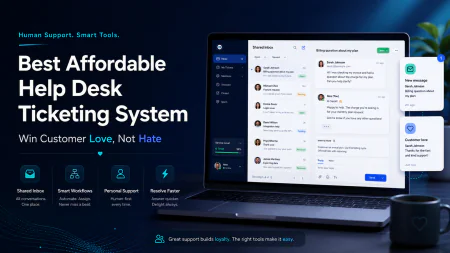
The Best Affordable Help Desk Ticketing System to Win Customer Love (Not Hate)
Ditch the bloated, expensive tools that frustrate users. Discover the best affordable help desk ticketing system options that simplify support and delight customers.
 Abir Bin Hasan

The Best Affordable Help Desk Ticketing System to Win Customer Love (Not Hate)
Customer service has run into a strange paradox. In trying to scale support, many teams have accidentally built walls between themselves and their users. They traded quick, human emails for sterile, multi-step support portals that treat people like database rows. Returning to a more personal approach doesn't require a massive budget; it just requires a clean, straightforward support platform that organizes incoming queues without cluttering the customer experience.
What this article helps you decide
If you are overwhelmed by vendor pitches, this guide will help you cut through the marketing noise. We analyze lightweight support options based on the true cost of ownership, seat-licensing traps, implementation speed, and how the software actually feels to your end users. By the end, you will know exactly which platform matches your daily workflow and keeps your budget intact.
Analysis Methodology
This guide is compiled through a thorough analysis of official service agreements, publicly accessible enterprise documentation, and genuine discussions among real-world developers, professionals, and users on technical forums like r/sysadmin, r/SaaS, and r/ITManagers. We cross-referenced user reviews from platforms like G2 and audited technical documentation from vendors including Help Scout, Desk365, and Hiver. Our evaluation focuses on authentic utility, verified cost structures, and actual user experiences rather than marketing claims.
Overview & Market Context: The Death of the "Enterprise Portal"
For over a decade, the standard playbook for scaling customer support was simple: purchase a heavy-duty enterprise customer service suite, configure complex routing rules, and force customers to log into a dedicated portal to view their tickets. However, modern users have grown weary of this friction. Forcing customers to register for a portal login just to check a simple ticket status is now a primary driver of frustration. It signals to the customer that your internal tracking process is more important than their convenience.
Consequently, the market has seen a strong counter-movement toward "invisible" support software. The most customer-friendly help desks are completely invisible to the end user—appearing simply as a personal, timely email exchange. When a customer sends an email, they receive a well-formatted, human reply from a real person, with absolutely no mention of "Ticket #98432" or automated demands to log into a secondary system.
 Modern help desk software prioritizes invisible, email-first communication to keep support personal and human.
In addition, there is a fundamental difference in support philosophy between B2B and B2C dynamics:
- B2B Support: Requires deep account-level context, historical relationship-building, and collaborative support across multiple stakeholders. Speed is important, but resolution accuracy and context-awareness are paramount.
- B2C Support: Prioritizes rapid deflection, high-volume automated routing, self-service knowledge bases, and quick ticket-closing metrics.
Unfortunately, many legacy tools try to force both models into the same bloated mold, resulting in a complex system that serves neither group effectively. This complexity is often weaponized by legacy help desks to justify high agent seat pricing and steep upsells for basic automation features.
In-depth Evaluation: Finding the Right Budget-Friendly Ticketing System
To help you find a non-bloated solution, we have thoroughly analyzed the leading platforms across several crucial dimensions: front-end customer experience, agent usability, implementation friction, and genuine long-term pricing structures.
1. Help Scout: The Champion of Email-First Support
Help Scout has built its entire brand around the concept of "email-first support." Unlike platforms that make your support look like an sterile IT service desk, Help Scout ensures that every communication sent through their platform looks exactly like a standard, personal email to the recipient. The customer does not see ticket numbers, tracking IDs, or robotic system indicators.
Setup & Configuration Flow
Setting up Help Scout takes minutes rather than weeks. You connect your support email address via direct integration (such as Google Workspace or Microsoft 365) or standard forwarding. You can quickly configure a shared inbox, add your team members, and customize a public-facing knowledge base ("Docs") without writing a single line of code. There are no complicated routing matrices to build; instead, you rely on simple, clean workflows that execute actions based on conditions (e.g., if a subject line contains "billing," tag it and assign it to the finance team).
Usability & Performance Metrics
The agent dashboard is clean, fast, and organized. It behaves similarly to a standard email client but includes powerful collaborative support features like internal notes, collision detection (which prevents two agents from replying to the same email at once), and saved replies. Because the user interface lacks clutter, system lag is virtually non-existent, even when multiple agents are handling dozens of parallel conversations.
True Pricing & Value Analysis
Help Scout offers clear, predictable tiers starting at around $20 to $25 per user per month. There are no hidden fees for basic reporting, and unlike older platforms, they do not hold your historical data hostage behind expensive enterprise upgrades. By avoiding the typical agent seat pricing creep, it stands out as an excellent Zendesk alternative for growing teams.
Limitations & Warnings
If your team handles highly structured ITIL change-management processes, asset tracking, or requires a physical hardware registry, Help Scout will feel too bare-bones. It also lacks deep native telephony features out of the box, meaning teams that rely heavily on complex phone routing will have to configure third-party integrations.
2. Hiver: The Gmail-Native Shared Inbox
For organizations that run entirely on Google Workspace, Hiver offers an incredibly simple support ticket tool that operates directly inside the familiar Gmail interface. Instead of forcing your agents to learn a completely new software dashboard, Hiver overlays collaboration features directly on top of your existing Google Workspace account.
Setup & Configuration Flow
Because Hiver is built specifically for Gmail, implementation is incredibly simple. Agents install a lightweight Chrome extension, and administrators grant the platform access to the shared email addresses (e.g., info@, support@, sales@). There is no need to redirect email MX records or configure external email-forwarding parameters. This direct overlay prevents teams from getting lost in 200-step configuration menus, a common complaint regarding standalone help desks.
Usability & Performance Metrics
Hiver excels in collaborative support without adding technical complexity. Within Gmail, agents can assign emails to specific team members, write private internal notes on email threads, track status tags (Open, Pending, Closed), and build lightweight ticketing workflows. It prevents the panic of "shared Gmail label hell," where teams use manual labels to coordinate support only to find that previous quarters' tickets have gotten permanently buried under incoming traffic.
True Pricing & Value Analysis
While Hiver is highly convenient, its pricing model is strictly tied to Google Workspace accounts. Because every user who interacts with the shared inbox needs a Hiver seat, adding non-support seats (such as engineers or founders who only occasionally triage tickets) on per-seat plans can quickly inflate your monthly bill if you are not careful. However, for teams already fully integrated into Gmail, it remains a highly efficient, lightweight help desk platform.
Limitations & Warnings
Because Hiver runs as an overlay on Gmail, massive support volumes (hundreds of tickets per agent daily) can occasionally cause the browser extension to lag or clutter the native Gmail interface. Additionally, if your business ever decides to migrate from Google Workspace to Microsoft 365, you will have to rebuild your entire support workflow from scratch on a different tool.
3. Desk365: The Microsoft Teams-First Ticketing System
If your company runs on Microsoft 365 and relies heavily on Microsoft Teams for internal and external collaboration, Desk365 offers a unique, highly affordable ticketing option designed to bridge the gap between chat apps and customer support.
Setup & Configuration Flow
Desk365 integrates directly with Microsoft Teams, allowing your agents to manage tickets, view queues, and reply to customers without ever leaving their active Teams workspace. Setting up the platform involves authorizing the Desk365 app within your Microsoft 365 Admin Center, creating your support mailboxes, and mapping them to specific Microsoft Teams channels.
Usability & Performance Metrics
When a customer sends an email or submits a message through live chat, Desk365 instantly notifies your designated Teams channel. Agents can claim, categorize, and resolve the ticket using simple interactive cards directly inside Teams. This approach minimizes context-switching, keeping your internal communication incredibly fast and cohesive. For teams already working in Teams all day, Desk365 eliminates the friction of managing a separate browser tab for customer support.
True Pricing & Value Analysis
Desk365 is widely regarded as one of the most cost-effective ticketing systems on the market, offering flat, highly competitive pricing that avoids the premium markups of older platforms. It delivers standard help desk features, such as custom ticket fields, auto-responders, and basic automation, at a fraction of the cost of enterprise alternatives.
Limitations & Warnings
If your team does not actively use Microsoft Teams as its primary internal workspace, Desk365 loses its main competitive advantage. While it does have a standalone web portal, the interface is basic and lacks the visual refinement and advanced reporting analytics found in dedicated standalone web platforms.
 Desk365 allows teams working inside Microsoft Teams to triage, discuss, and resolve tickets natively.
4. The Cost of Legacy Giants & Open-Source Traps
To understand the true value of these simple systems, we must examine what happens when teams choose legacy systems or "free" open-source options.
The Enterprise Suite Dilemma (e.g., Zendesk)
Enterprise suites like Zendesk are engineered for massive, 200+ person call centers with highly complex routing needs. When smaller teams adopt these tools, they are met with a tedious setup process, countless unnecessary features, and aggressive pricing plans. A small 20-person company recently reported that Zendesk quoted them $3,000 monthly for support software they barely utilized 20% of, leading them to quickly migrate to simpler customer support alternatives.
The ITIL-Heavy Approach (e.g., Jira Service Management)
Jira Service Management excels at ITIL processes, asset management, and deep developer integrations. However, it presents a steep learning curve and a busy, highly technical interface that non-technical users find alienating. If your primary goal is external customer support rather than internal software engineering support, forcing your customer service agents to use Jira often leads to user fatigue and cold, overly structured customer communications.
The Open-Source Mirage (e.g., osTicket, GLPI)
At first glance, open-source ticketing tools like osTicket or GLPI appear to be the ultimate cheap option. They are free to download, but they carry significant hidden maintenance, server, and setup costs for non-technical teams. You are responsible for security patches, server uptime, database backups, and manual integrations. When something breaks, your team is left without dedicated support, which can result in costly downtime that far outweighs the price of an affordable SaaS help desk.
💡 Expert Analysis & Experience
A deep dive into community discussions on r/sysadmin reveals a shared frustration with the "support theater" encouraged by legacy enterprise tools. Sysadmins consistently report that overly complex reporting dashboards incentivize agents to prioritize fast response times over actual resolution quality. Furthermore, many complain about the clunky web and mobile apps in legacy platforms like Spiceworks Cloud, which has prompted many teams to shift to lightweight tools like Hiver or Desk365 to keep their setups simple and clean.
We also see a growing backlash against recent pricing shifts in the market. For instance, Freshdesk's decision to discontinue its free tier has forced small business owners to scramble for cost-effective alternatives, while legacy help desks have begun charging up to $50/agent/month for basic AI add-ons—essentially negating the cost-efficiency of the base software.
Help Desk Ticketing Systems Comparison
The following table provides a direct comparison of the top affordable help desk platforms alongside standard enterprise options to help you evaluate which platform fits your operational model.
| Platform | Target Audience | Primary Workspace | End-Customer Experience | Setup Complexity | Relative Cost |
|---|---|---|---|---|---|
| Help Scout | Growing SMBs, B2B & B2C teams | Clean Standalone Web App | Excellent (Invisible, Personal Email) | Low (Self-serve in minutes) | Moderate / Highly Fair |
| Hiver | Google Workspace Teams | Native Gmail Inbox | Excellent (Seamless Personal Email) | Very Low (Chrome Extension) | Moderate (Per-seat pricing) |
| Desk365 | Microsoft 365 & Teams Users | Native MS Teams Interface | Good (Clean Email / Live Chat) | Low (Microsoft App Integration) | Very Low (Highly Affordable) |
| Zendesk | Massive Enterprise Call Centers | Complex Standalone Web Portal | Variable (Often forces portal login) | Very High (Requires consultants) | Extremely High (Hidden fees) |
| osTicket | Self-reliant, highly technical teams | Self-hosted Web Dashboard | Basic (Standard Ticket Portal) | High (Requires server config) | Free base software (High upkeep cost) |
Practical Scenario: Solving Support Overload in a Fast-Growing SaaS Company
Let's look at a concrete, real-world scenario to see how choosing the right tool impacts daily operations. A small B2B SaaS startup with 12 employees was managing all customer inquiries through a shared Google Group address (support@company.com). As their user base grew, they found themselves in "shared Gmail label hell." Multiple employees were replying to the same customer, critical bugs were being missed, and older requests from previous quarters were getting permanently buried under new incoming messages.
Initially, the team set up a trial of Zendesk. However, they quickly realized that they were spending more time configuring custom ticket routing rules, SLA targets, and user roles than actually talking to customers. The customer experience suffered as users began receiving automated emails containing impersonal strings like "Your request [Ticket #48291] has been received..." and were prompted to create a password-protected portal account to view the response.
Recognizing the friction this created, the startup decided to transition to Help Scout's email-first support platform. This lightweight software allowed them to integrate their support address instantly while keeping the customer's experience completely personal. Customers simply sent an email and received a standard reply from a real person. Internally, the support team utilized invisible shared inboxes, saved replies for common questions, and internal notes to coordinate with engineers on complex bugs without having to pay for expensive non-support seats on a per-seat plan.
✅ Pro Tip
When selecting your help desk platform, always verify the true cost of adding "light agents" or "collaborators." If your customer support agents need to ask your product engineers, designers, or founders for technical context on a ticket, some help desks force you to buy a full, high-priced seat for those occasional users. Look for platforms that offer free, limited "light seats" or allow simple, internal mention features that don't inflate your monthly bill.
Pricing & Licensing Breakdown: Navigating the Hidden Costs
When searching for a cost-effective support tool, it is easy to fall into pricing traps that quickly blow up your budget. Here is what to look out for before signing a contract:
1. The Seat Inflation Trap
Most modern support platforms charge on a per-agent, per-month basis. While $20/month sounds incredibly affordable, the math changes quickly when you need to pull in teammates from other departments to resolve complex issues. Look for platforms that offer free collaborator seats, basic email forwarding, or internal comment systems that do not require purchasing additional full licenses.
2. The AI Tax
Artificial Intelligence features like automated ticket summarization, macro suggestions, and draft generation are incredibly helpful. However, many legacy suites treat these as premium add-ons, charging as much as $50 per agent per month on top of your base subscription. Affordable alternatives like Desk365 or Help Scout increasingly bundle basic productivity AI features directly into their mid-tier plans, giving you modern efficiency without a massive cost markup.
3. Self-Hosting vs. SaaS Costs
It can be tempting to use open-source software like osTicket to completely avoid seat-licensing fees. However, you must factor in the cost of server hosting, manual updates, security monitoring, and the lost productivity of your IT team. For almost all small-to-medium businesses, a managed SaaS ticketing system is more cost-effective over the long run than managing your own secure customer support infrastructure.
Balanced Comparison: Lightweight Help Desks vs. Enterprise Suites
Lightweight Help Desk Platforms (Pros)
- Invisible to Customers: Keeps support personal and conversational without forcing portal logins.
- Rapid Implementation: Go live in minutes rather than spending weeks in configuration menus.
- Predictable Costs: Simple, transparent agent seat pricing with few hidden upgrade fees.
- Lower Friction: Clean interfaces keep your support team focused and prevent software fatigue.
Lightweight Help Desk Platforms (Cons)
- Limited Customization: May lack deep ITIL compliance workflows required by enterprise IT departments.
- Simpler Reporting: Analytics dashboards focus on core performance rather than complex, highly granular custom metrics.
- Fewer Native Integrations: May require middleware like Zapier to connect with highly specialized, niche business systems.
Who should use what?
Your ideal platform depends entirely on your existing technology stack and how your support team works on a daily basis:
- Choose Help Scout if you are a customer-centric B2C or B2B brand that wants to keep your communication completely invisible, human, and conversational, while still maintaining structured shared inboxes and a clean, public knowledge base.
- Choose Hiver if your organization runs entirely on Google Workspace and you want your team to manage collaborative shared support addresses directly from their existing Gmail accounts without learning new software.
- Choose Desk365 if your company is built around the Microsoft 365 ecosystem and you want to manage, discuss, and resolve support requests directly within Microsoft Teams.
- Choose Jira Service Management only if you are an engineering-driven IT organization that must strictly adhere to structured ITIL incident management practices and complex developer workflows.
Recommended Choices by Purpose
There is no single global winner when it comes to customer support software. If your priority is unmatched ease of use and human feel, Help Scout is the standout choice. If your priority is seamless, native integration with Google Workspace, Hiver is your best option. For teams seeking highly cost-effective, Microsoft-centric collaboration, Desk365 offers incredible value. Avoid enterprise suites unless your support team exceeds 100 concurrent agents and requires complex, highly customized database configurations.
Common Questions
Do I really need a customer-facing support portal?
For most modern B2C and lightweight B2B operations, the answer is no. Portals create unnecessary friction by requiring customers to register, remember passwords, and log in just to check a ticket status. Email-first communication, where updates arrive directly in the customer's inbox, is faster, more personal, and far more convenient for the end-user.
Can we use a simple shared inbox instead of a dedicated ticketing system?
While a standard shared inbox (like a Google Group or shared Microsoft Outlook inbox) works well for small teams, it eventually leads to collision issues (two agents replying to the same customer at once), unassigned emails, and a lack of clear ownership. A lightweight help desk platform solves these problems by adding collision detection and clear ticket assignments behind the scenes, while keeping the front-end communication looking like a standard email to the customer.
Is open-source help desk software actually free?
No. While the source code of platforms like osTicket is free to download, you must pay for secure server hosting, database storage, email delivery integrations, and ongoing maintenance. Furthermore, if you do not have in-house technical resources to manage updates and security patches, the risk of technical downtime can quickly make open-source options far more expensive than a reliable, affordable SaaS help desk.
How do per-seat pricing models impact our budget as we grow?
Per-seat models charge a flat rate for every single user added to the help desk. To keep your costs predictable as you grow, look for platforms that offer free read-only seats, lightweight collaborator licenses, or flexible pricing tiers that allow you to loop in external departments without paying for full support seats.
Step-by-Step Implementation Checklist
Once you have selected your support platform, use this checklist to ensure a clean, friction-free implementation:
- Audit current support volume: Determine if your team actually needs a complex ticket-routing engine or if a clean, shared email inbox is better for your volume and customer relationships.
- Verify the pricing model: Carefully check for seat-pricing creep, ticket volume caps, or hidden monthly costs for essential automated workflows.
- Evaluate user interface friction: Choose platforms that allow your customers to get help instantly without forcing them to navigate complex multi-step drop-down menus before submitting an issue.
- Connect your communication channels: Ensure the software integrates natively with your team's primary communication tools (such as Slack, Microsoft Teams, or Google Workspace) to minimize context-switching.
- Draft friendly auto-replies: Set up warm, personal auto-responders that manage response expectations without using cold, robotic jargon or impersonal ticket numbers.
- Build a friendly knowledge base: Launch a simple, searchable help center to answer common questions, giving your users fast self-service answers and keeping easy, repetitive queries out of your queue.