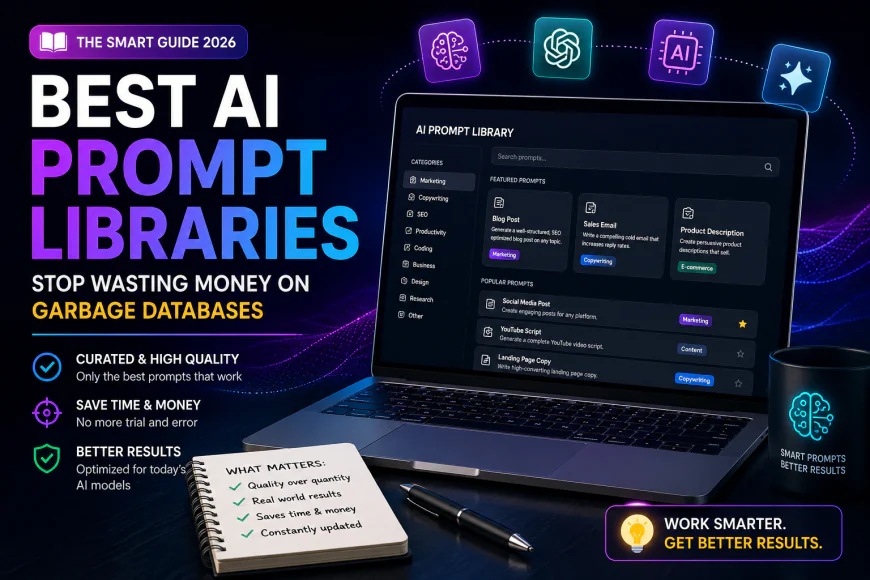
Best AI Prompt Libraries: Stop Wasting Money on Garbage Databases
Stop paying for overpriced, bloated prompts. We review the best AI prompt libraries of 2026, comparing premium prompt databases vs free alternatives.
 Abir Bin Hasan
Best AI Prompt Libraries: Stop Wasting Money on Garbage Databases
The early days of the generative AI boom felt like a digital wild west, with self-proclaimed prompt engineers selling basic copy-paste text templates for a quick profit. However, as advanced LLMs like Claude 3.5 Sonnet and GPT-4o have grown highly adept at interpreting natural intent, professional workflows are shifting. Today, the most effective resources for structuring AI inputs are often completely free, while massive paid databases are frequently bloated with counterproductive filler that actually degrades model performance.
What this article helps you decide
This guide cuts through the marketing noise to help you identify which prompt repositories are worth a bookmark, how to separate high-value engineering resources from low-effort cash grabs, and whether your workflow is better served by free open-source platforms, dynamic developer-focused tools, or specialized visual databases.
Analysis Methodology
This guide compiles insights from a thorough analysis of official developer documentation, GitHub repositories, and actual discussions among working developers, data scientists, and prompt engineers on technical forums. By looking past marketing claims, this analysis exposes which resources offer genuine structural utility and which ones merely repackage basic commands that anyone could write in five seconds. Rather than relying on simulated experiences, we focus on real-world limitations and verified corporate use cases.
Overview & Market Context: The Death of the Static Prompt Marketplace
There was a brief period when selling a PDF containing 10,000 "secret" ChatGPT commands was a viable side hustle. Today, that business model is fundamentally broken. Modern LLMs are highly sophisticated reasoning engines rather than simple keyword matchers. They do not require elaborate, pseudo-scientific incantations to perform standard business tasks. Instead, professional prompt engineering has moved away from static copy-paste text strings toward dynamic prompt management, API-level version control, and structured system instructions.
The core issue with many commercial databases is a phenomenon machine learning researchers call "attention dilution." Transformer-based models assign weights to different parts of your input. When a "premium" prompt is heavily padded with repetitive marketing buzzwords—like "write like an award-winning, world-class, genius marketer with a PhD in human psychology"—it dilutes the model's focus. The actual, critical instructions get lost in the noise, leading to generic, over-designed outputs. Because of this, experienced builders are migrating toward official developer documentation and open-source systems.
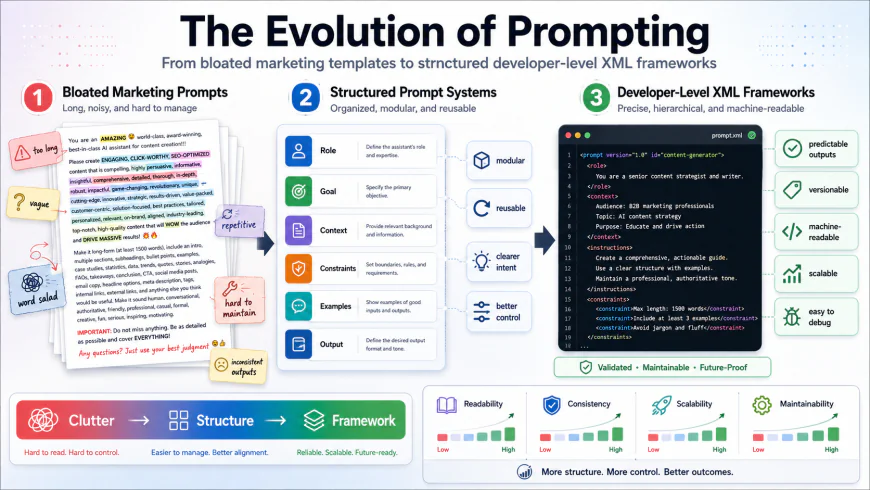 The evolution of prompting: from bloated marketing templates to structured developer-level XML frameworks.
In-depth Evaluation of the Best AI Prompt Libraries
1. Anthropic Official Prompt Library: The Gold Standard for Claude
For those who spend their workdays inside Claude 3.5 Sonnet or Claude 3 Opus, the official Anthropic Prompt Library is easily the strongest starting point. It’s a free, open-source resource maintained directly by the researchers who train the models, meaning the templates leverage the exact structural patterns Claude is optimized to interpret.
Instead of vague instructions, Anthropic's repository relies on clean XML tags (such as
2. OpenAI Developer Examples: Clean, Production-Ready Logic
For workflows centered around GPT-4o or the reasoning-focused o1 series, the OpenAI Examples Database is an invaluable reference point. This isn't a marketplace designed to sell you basic copy; it's a technical catalog of system prompts and structured data schemas that serve as an educational blueprint for API integration.
Where this collection shines is its focus on structured outputs, tool calling, and API integration. The examples demonstrate how to construct system prompts that force the model to output valid JSON or execute complex, multi-step tasks. Because they are designed for developers, the templates are lean, clean, and optimized to keep API token usage to a minimum. The downside is its high technical barrier: non-technical users may struggle to adapt these raw API-focused templates to standard chat interfaces without some basic coding knowledge.
3. PromptHero: The Vital Hub for Visual Generation
While text models are conversational, image generators like Midjourney, Stable Diffusion, and Flux operate on a completely different logic. These diffusion models rely heavily on specific, non-intuitive technical terms, camera lens settings, and lighting styles. This is where a dedicated search engine like PromptHero is genuinely useful.
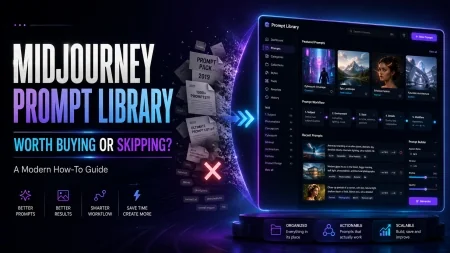
PromptHero functions as a community-driven repository where creators share high-quality generated images alongside the exact prompt syntax and model version used to make them. Because visual prompting often requires knowing specific phrases (like "octane render," "volumetric lighting," or "f/1.8 depth of field"), having a visual, searchable database saves hours of guesswork. However, the free tier is heavily ad-supported, and the UI can feel slow and cluttered when searching through thousands of community submissions.
4. AIPRM Extension: High Utility for Solopreneurs, Blocked by Corporate IT
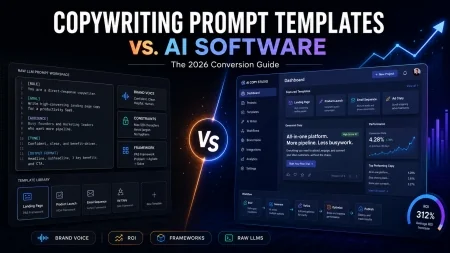
The AIPRM Chrome extension is highly popular among solo SEOs, copywriters, and content marketers. It embeds a massive, community-vetted library of templates directly into the ChatGPT interface, enabling users to trigger complex content generation tasks with a single click. For quickly mapping out a content calendar or generating keyword clusters, its convenience is hard to match.
However, AIPRM comes with a massive caveat for anyone working in a structured corporate environment: **IT security restrictions**. Because Chrome extensions require broad permissions to read and modify web page data, strict enterprise security policies frequently block unvetted browser extensions like AIPRM. Additionally, the premium tiers can quickly become expensive, with steep pricing jumps on renewal that can catch solo creators off guard.
5. PromptBase: The Shrinking Marketplace Model
PromptBase was a pioneer in the early AI space, establishing a marketplace where creators could buy and sell prompts for a few dollars. However, paying $1.99 to $9.99 for a static block of text is incredibly difficult to justify today when you can easily ask a modern model to generate its own high-quality prompt templates.
From a creator's perspective, PromptBase takes a hefty 20% commission cut. This high fee, combined with an aggressive ranking algorithm where a single negative review can tank a seller's search traffic, has driven many top-tier prompt engineers away from the platform. While it still holds some niche value for complex, multi-variable Midjourney or DALL-E 3 prompts where visual trial-and-error costs money, its utility for standard text-based tasks has dropped significantly due to rapid model obsolescence.
💡 Expert Analysis & Experience
Discussions across professional communities like r/PromptEngineering and r/ChatGPTPro highlight a clear trend toward self-reliance. As seasoned builders often point out, paying for a static template is rarely worth it when you can source the structural logic for free with minimal effort.
Furthermore, community feedback consistently warns that commercial static prompts suffer from rapid obsolescence. Whenever OpenAI or Anthropic rolls out a model update or adjusts backend system instructions, prompt behaviors change. A paid prompt that worked perfectly in October might yield mediocre results by January because the underlying model’s weights have shifted. In typical business scenarios, recent multi-week workflow evaluations by industry professionals show that free, framework-focused repositories consistently outperform rigid marketplace templates because they focus on reusable logic rather than brittle, copy-paste phrasing.
The Definite Proof: Premium vs. Free AI Prompts
To see if paid databases offer any real ROI, it helps to look at structured comparisons. A notable blind-test study conducted by the SEO team at Ahrefs pitted $80 worth of premium purchased prompts against simple, direct human commands. The goal was to see which outputs required less editing for real-world marketing use.
The results were telling: reviewers overwhelmingly preferred the outputs generated by the simpler, free instructions. The expensive "premium" prompts were packed with excessive boilerplate instructions, which caused the models to overcomplicate the writing and produce stiff, robotic copy. Simple prompts that directly defined the task, audience, and constraints allowed the model's natural reasoning capabilities to work unimpeded. This study highlights a broader industry consensus: over-engineered prompt databases are often an unnecessary capital expense.
| Prompt Resource | Cost Structure | Primary Use Case | Core Advantage | Major Limitation |
|---|---|---|---|---|
| Anthropic Prompt Library | 100% Free | Claude (Sonnet/Opus) optimization | Uses native XML tag structure; highly precise | Limited selection of non-work/business use cases |
| OpenAI Examples | 100% Free | GPT-4o developer workflows | Clean, minimalist, production-ready JSON and API examples | Highly technical; requires basic API understanding |
| PromptHero | Free with Premium tier | Midjourney, Flux, Stable Diffusion | Excellent visual search engine for technical style tags | Not built for advanced text-generation logic |
| AIPRM Extension | Free to $100+/month | Solopreneur SEO & content creation | One-click execution directly inside ChatGPT UI | Often blocked by corporate IT security policies |
| PromptBase Marketplace | Pay-per-prompt ($1.99 - $9.99) | Niche visual and specialized tasks | Saves time for highly complex image generations | High platform cuts; static text prompts quickly become obsolete |
Practical Scenario: The Bloated Prompt vs. The Structured Framework
To understand why premium databases are often counterproductive, let's look at an actual workflow example comparing a typical "premium" marketing prompt with a highly optimized, free structured framework.
1. The Bloated "Premium" Prompt (Often sold for $5.00 on marketplaces)
"Act as an award-winning, professional SEO copywriter with 15 years of experience in digital marketing. Write in a highly persuasive, human-like, non-robotic tone. Do not use words like explore, delve, or testament. You must carefully analyze the query and produce a 500-word blog outline in markdown format for [Topic]. Ensure you use bullet points and bold headers. Make sure it is highly engaging and optimized for search engines so it ranks on the first page of Google."
The Flaw: This prompt is incredibly wordy. Phrases like "ranks on the first page of Google" or "15 years of experience" are functionally useless to an LLM; they do not provide actionable guidelines on *how* to write. They simply consume valuable context window space.
2. The Simple Direct Prompt (Free & More Effective)
"Write a persuasive 500-word blog outline for [Topic] in markdown. Use a direct, professional tone. Avoid generic AI transition words (such as 'explore', 'delve', or 'testament') and do not include fluff."
The Result: The model receives clear, direct constraints. Because there is no filler, the attention heads of the model focus entirely on generating a high-quality outline structure.
3. The Advanced Model-Specific Structure (Anthropic XML Method)
The Result: By partitioning the prompt into distinct XML blocks, the model parses the context, instructions, and target data with near-perfect accuracy. This structure is completely free to construct and outperforms any paid prompt on the market.
✅ Pro Tip: Build Your Own Dynamic Prompt Library via Meta-Prompting
Stop paying third-party websites to write prompts for you. Instead, use "meta-prompting" to turn the AI into your personal prompt engineer. Simply copy and paste this system prompt builder into Claude or ChatGPT:
"I want you to act as an expert prompt engineer. I will give you a task, and your goal is to construct a highly optimized, structured prompt template for me. Use clear markdown, divide instructions from context, use XML tags if targeting Claude, and list all variable inputs inside brackets like [this]. Tell me what information you need first."
By using this approach, you can generate bespoke, highly technical prompts tailored perfectly to your specific business tasks for zero cost.
Pricing & Licensing Breakdown: Free Open Source vs. Enterprise Paid Databases
When deciding how to manage your prompt assets, understanding the financial and security implications is critical. The current market is split into three main avenues:
1. Completely Free Official Repositories
Platforms like the Anthropic Prompt Library and OpenAI Examples cost absolutely nothing. Furthermore, they are published under open, permissive developer licenses. You are free to copy, modify, and integrate these prompts directly into commercial software applications without any licensing fees or legal risks. For enterprise development, this is the safest and most compliant way to scale prompting strategies.
2. Paid Consumer Databases and Marketplaces
Single-item marketplaces like PromptBase or subscription services charge anywhere from $5 to $50 per month. The major limitation here is licensing ambiguity. When you buy a prompt from an individual creator on a marketplace, the intellectual property rights can be murky. If that prompt contains copyrighted terms or patented workflows, your business could face unforeseen compliance risks. Additionally, because you are paying for static text, the value-to-cost ratio degrades the moment a new model update is deployed.
3. Enterprise API Managers (The True Professional Route)
For mid-sized companies and software teams, the real value is not in static text databases, but in dynamic prompt management, testing, and versioning systems like Agenta, PromptLayer, and PromptHub. These tools do not sell you pre-written prompts. Instead, they provide a secure dashboard where your team can write, collaborate on, version-control, and A/B test your internal prompt templates via API. These platforms operate on standard SaaS subscription models (typically starting with a free developer tier and scaling up to enterprise pricing). This approach ensures that your prompts remain proprietary, secure, and fully integrated into your generative AI workflows.
Balanced Comparison: Free Official Libraries vs. Paid Consumer Databases
Free Official Libraries
- 100% free of charge with no hidden subscription fees.
- Engineered directly by AI research teams for maximum model compatibility.
- Free from bloated filler text, ensuring efficient token usage.
- Completely safe for commercial software integration and corporate compliance.
Paid Consumer Databases
- Highly prone to rapid obsolescence when models undergo backend updates.
- Frequently stuffed with meaningless filler words that dilute the model's focus.
- No quality guarantees or standardized testing across model versions.
- Chrome extensions are often blocked by corporate IT security policies.
Who should use what?
To help you save time and budget, we have categorized the optimal choices based on your specific professional role and technical requirements:
- Software Engineers & Product Developers: Stick exclusively to the OpenAI Examples Database, the Anthropic Prompt Library, or integrate professional-grade development platforms like PromptLayer. Avoid low-quality consumer databases entirely.
- Digital Artists & Designers: Use PromptHero or active community hubs (like r/Midjourney) to search for complex style tags, lighting terms, and camera settings.
- Solo Marketers & Copywriters: Take advantage of the free tiers of tools like AIPRM, but focus on mastering clear, direct instructions rather than buying bloated "marketing databases."
- Enterprise Teams & Organizations: Block unvetted browser extensions. Set up a secure, centralized markdown repository on your company’s internal GitHub or use a dedicated enterprise tool like PromptHub.
The Bottom Line: What to Choose
If you want flawless technical performance without spending a dime, stick directly to the official libraries from Anthropic and OpenAI. If you are focused on AI art and visual design, PromptHero is incredibly useful for reverse-engineering style tags. For scaling a business securely, ignore public databases altogether and use professional, API-driven prompt management software like PromptHub, PromptLayer, or Agenta to host and test your own team's frameworks.
Frequently Asked Questions
Should I ever pay for a prompt database?
Almost never. Real-world testing shows that simple, direct human instructions usually beat bloated "premium" prompts anyway. Plus, you can easily ask the AI models themselves to generate high-quality prompt structures for you for free.
Why do my saved prompts stop working after a model update?
AI companies continuously fine-tune their models, modifying their baseline behaviors and safety parameters. When a model gets updated, the way it interprets specific phrasing shifts, which often breaks rigid, over-engineered prompts.
Why does corporate IT block browser extensions for prompts?
Most corporate security teams ban unvetted extensions because they can read, track, or leak sensitive data from your web pages. To protect intellectual property and private customer data, companies prefer native or API-based solutions.
What is the difference between a system prompt and a user prompt?
A system prompt defines the underlying rules, persona, and constraints of the AI (usually set in the background or via API). A user prompt is the actual request or query you type into the chat window during a session.
How do XML tags improve prompt accuracy?
XML tags (such as
The Professional Prompting Checklist
Before you build your workflows or spend a single dollar, use this quick checklist to keep your prompts clean, effective, and free:
- Set a baseline: Always test a basic, direct instruction before trying an elaborate, multi-step prompt template.
- Cut the fluff: Remove generic filler words and empty phrases like "act as an expert" if they aren't actually guiding the model's logic.
- Leverage native features: Use structured formatting like Anthropic’s XML tags or OpenAI’s JSON schema mode where appropriate.
- Own your assets: Keep your prompt library saved locally in markdown files or a private GitHub repository instead of relying on a third-party directory.
- Test during updates: Review and run A/B tests on your core prompts whenever a provider rolls out a new model version.