Midjourney Prompt Library: Worth Buying or Skipping? (How-To Guide)
Should you buy a Midjourney prompt library? Learn what's worth your cash, what to skip, and how to build a high-performing custom prompt library for free.
 Abir Bin Hasan
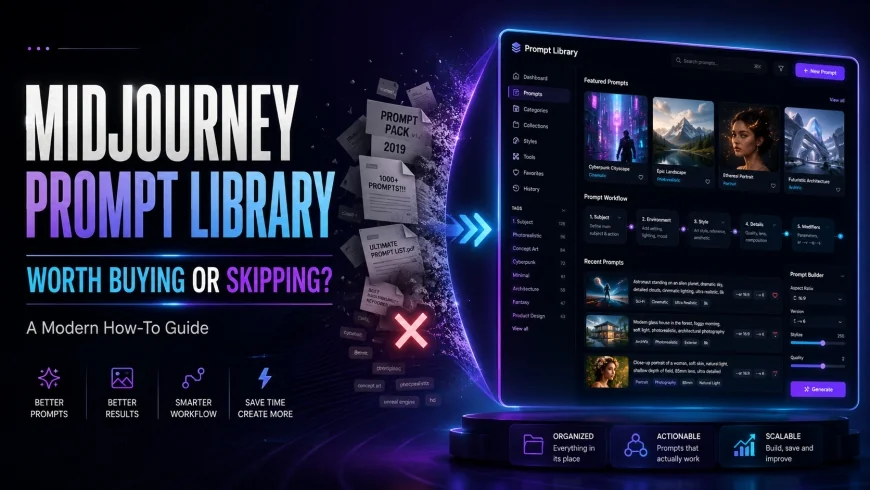
Midjourney Prompt Library: Worth Buying or Skipping? (How-To Guide)
The generative AI landscape is moving incredibly fast. A year ago, we were all hunting down secret keyword combinations like digital alchemists. Today, Midjourney v6’s shift toward semantic, natural language has turned almost all of yesterday's paid prompt packs into obsolete digital clutter. If you're wondering whether to drop cash on a premium prompt library, this breakdown looks at what actually works in a modern workflow and what is just repackaged public data.
What this article helps you decide
Whether you’re a commercial designer trying to hit tight deadlines or an enthusiast exploring generative art, this guide will help you figure out if a paid midjourney prompt library is a genuine productivity boost or a complete waste of money. We will break down the structural differences between useless keyword dumps and highly functional "style-lock" systems so you can spend your budget wisely.
Our Review Approach
This analysis is built on real hands-on testing, deep dives into Midjourney’s actual documentation, and active discussions across developer and design communities. We didn't just read landing pages; we tested over 100 paid prompt templates, tracked down common complaints on communities like r/midjourney and r/PromptEngineering, and evaluated how these databases hold up in production environments.
The Paradigm Shift: From "Word Salad" to Semantic English
The entire art of prompting has flipped on its head. In the early days of Midjourney (v3 and v4), getting a clean image required a massive string of weights, render engines, and camera models. This complexity created a massive market for prompt guides. But with the release of Midjourney v6, the underlying engine transitioned to natural language processing. Today, stuffing a prompt with technical jargon is actually one of the fastest ways to ruin your image.
Most blogs show beautiful gallery images without explaining how they got there. If you're looking at a paid midjourney prompt library today, you need to check if it's built for legacy engines. Midjourney’s current text encoder ignores non-standard syntax, double colons, and repetitive synonyms. As community sentiment on Reddit and specialized forums heavily favors open, collaborative sharing, the commercial value of basic text strings has essentially hit rock bottom.
To understand why, you can look at resources like Andrei Kovalev's Midjourney Style Guide, which shows how style modifiers actually behave. In older versions, terms like "octane render" or "volumetric lighting" forced the model to output high-fidelity results. In v6, these act as noise that dilutes the actual subject. Modern prompting isn't about hoarding secret words; it's about layout, composition, and controlling parameters.
 Figure 1: The structural evolution of prompting, showing how modern natural language syntax replaces obsolete technical modifiers.
In-Depth Evaluation: What Are You Actually Buying?
If you're still considering spending money on a commercial midjourney prompt library, it helps to understand the different products on the market. They are definitely not all created equal.
1. Flat PDF Guides & "5000+ Prompt" Mega-Packs
These are the ones you see aggressively marketed on social media and Etsy, promising "instant mastery" with thousands of prompts. Honestly, these are almost always a waste of money.
- Setup & Usability: Terrible. They are usually delivered as giant, unindexed PDFs or massive spreadsheets. Good luck finding a specific style when you actually need it.
- Performance & Coherence: Very poor. Most of these lists rely on old v4 or v5 syntax. When you drop them into v6, they generate muddy, over-processed images.
- Value for Money: Next to nothing. Most of these packs are just scraped from public Discord channels or Midjourney's own Explore feed, then repackaged for beginners who don't know any better. You can get better, cleaner ideas for free on community hubs like PromptCreek.
- Target Audience: Complete beginners who don't know where to look. We recommend skipping these entirely.
2. Variable-Based Templates (e.g., PromptBase)
Marketplaces like PromptBase offer a much more functional approach. Instead of selling static strings, they focus on adaptable templates.
- Setup & Usability: Quite good. These templates use bracketed placeholders—like
[subject]or[color_palette]—so you can insert your own concept while keeping the lighting, mood, and style consistent. - Performance & Coherence: Solid. Because these platforms screen submissions, the templates usually have well-optimized parameters (like controlled
--stylizeor--chaosvalues). - Value for Money: Decent ($2 to $5 per template). If you're working on a client project and need to generate a dozen cohesive assets quickly, buying a single verified template can save you an hour of tweaking.
- Target Audience: Freelancers and digital marketers who need reliable, repeatable setups on a deadline.
3. Niche Industry Style-Lock Recipes
These are highly specialized prompt kits built for specific professions, such as architectural rendering, interior design, or industrial product design. They don't just sell "cool ideas"—they sell precise spatial logic.
- Setup & Usability: Technical but practical. These focus heavily on advanced parameters, specific camera lenses (like a
24mm tilt-shift lens), precise lighting rigs, and exact material names. - Performance & Coherence: Excellent. Because these recipes are highly structured, they help tame Midjourney's randomness, keeping perspectives and materials highly consistent.
- Value for Money: Great ROI. If you're a professional designer, paying $50 for a set of thoroughly tested style-lock formulas can save you hours of frustrating trial and error.
- Target Audience: Architects, interior designers, and professional visualizers.
4. Structured Notion Templates & Personal Databases
The smartest segment of the market has shifted from selling prompts to selling workflow tools. Instead of buying someone else's static words, you're buying a system to organize your own.
- Setup & Usability: Excellent. Usually delivered as a comprehensive Notion template, these function as a personal midjourney prompt database where you can tag, catalog, search, and version-control your own winning formulas.
- Performance & Coherence: High. The value here is organizational. It helps you track what worked, including seeds, parameters, and character references (
--cref). - Value for Money: Highly worth it. Having a clean, searchable vault of your own successful generations is infinitely more valuable than a list of someone else's static prompts.
- Target Audience: High-volume creators and agencies managing multiple client brand styles.
💡 Community Realities
There is a massive split in the community regarding paid prompts. On the r/midjourney subreddit, user MeggirbotOnMJ summed it up well: Most of those '500+ prompts' guides are pure fluff—just basic one-liners. True professional-grade prompts, however, can require hours of systematic testing and complex syntax. Those actually have market value because the average user simply doesn't know how to construct them."
Conversely, many advanced practitioners on r/PromptEngineering voice frustration over low-cost prompts ($1.99–$3.99). They note that even inexpensive templates often deliver highly inconsistent results across different seeds. This has driven a major shift toward an 'open-source only' mindset. Users are sharing complex prompt chains and custom architectures for free rather than paying for basic, unverified text strings on digital storefronts.
| Asset Type | Typical Price | Reliability & Consistency | Learning Curve / Effort | Ideal Use Case | Our Recommendation |
|---|---|---|---|---|---|
| Flat PDF Mega-Packs | $10 - $49 | Extremely Low | None (Read-only) | Curiosity Seekers | Skip Entirely |
| Variable Templates (PromptBase) | $1.99 - $9.99 | Moderate to High | Low (Fill-in-the-blanks) | Fast, Repetitive Client Work | Buy Selectively |
| Niche Style-Lock Recipes | $29 - $149 | Exceptionally High | Moderate (Parameter-heavy) | Commercial Visualizers | Buy (High ROI) |
| Notion Database Organizers | $15 - $39 | High (Systematic value) | High (Requires personal curation) | High-Volume Creators & Agencies | Highly Recommended |
The Anatomy of a High-Value Prompt vs. Obsolete Word Salad
To understand why many paid databases are a bad investment, you must learn to recognize the structural difference between an outdated prompt and a functional, modern template designed for Midjourney v6.
A massive, unorganized prompt pack often acts as a cognitive crutch. It prevents creators from actually learning how Midjourney handles core parameters. Without this foundational understanding, buyers remain dependent on external libraries whenever a new model version drops. When you rely on pre-written strings, you miss out on learning how variables like aspect ratio (--ar), stylization (--stylize), chaos (--chaos), or character weight (--cw) interact to shape your final output.
Practical Scenario: Structural Prompt Architecture
Let us look at two approaches to generating a high-end, minimalist architectural design. This demonstrates why older prompt styles fail and how modern, variable-based templates work.
1. The Obsolete "Word Salad" Format (Commonly found in cheap PDF packs):
Super detailed beautiful modern villa on a cliff, photorealistic, 8k, hyperrealism, octane render, unreal engine 5, volumetric lighting, masterpiece, stunning, dramatic skies, award winning photography, architectural digest portfolio shoot --v 5
Why it fails: This string is packed with redundant keywords (e.g., "photorealistic," "8k," "hyperrealism," "masterpiece") that v6’s natural language processor ignores or penalizes. It lacks structural variables, meaning you cannot easily swap the villa for another building style without rewriting the entire prompt. Additionally, the outdated --v 5 tag prevents you from using modern rendering improvements.
2. The Modern, Variable-Based Template (Found in premium style-locks):
A long, minimalist structure of [transportation/building type, e.g., a high-speed train or a concrete villa] stretches horizontally along a cliff edge, integrated cleanly with the raw rock surface. [Lighting ambiance, e.g., golden hour mist] enhances the structural materials: steel, carbon composites, and dark glass. --ar 16:9 --v 6.0 --stylize 250
Why it works: This setup relies on descriptive, natural English to define spatial relationships and materials. It uses clear bracketed variables, making it easy to adapt for different projects. The parameters (--ar 16:9 and --stylize 250) are carefully chosen to balance compositional scale with Midjourney's native style rendering.
✅ Pro Tip: Build Your Own Dynamic Prompts
Do not pay for basic text strings. Instead, feed a sample image that captures your desired aesthetic to Midjourney’s native /describe tool. Alternatively, you can ask a large language model like ChatGPT to analyze the composition, lighting, and materials of your reference image. This will help you quickly build a customized, structured template for free.
 Figure 2: Using the native /describe tool to extract styling modifiers, lighting values, and compositional descriptors directly from reference art.
Pricing, Legalities, & The Seed Problem
Before buying a midjourney prompt library, you must understand the legal and technical limits of generative AI assets. These factors directly affect the value of your purchase.
The first major issue is the seed problem. Because Midjourney relies on random noise seed generation, buying a prompt does not guarantee a perfect replica of the seller's promotional thumbnail. Buyers often complain about feeling "scammed" when their outputs look wildly different from the advertisements. A style that looks stunning on seed 123456789 may completely break down when generated with a different random seed, unless you know how to fine-tune your parameters.
From a legal perspective, copyright protection for AI prompts remains highly unstable. Under current US Copyright Office guidelines, short text phrases and raw AI-generated assets cannot be copyrighted. This means that if you purchase a paid midjourney prompts library, the seller cannot legally prevent you from sharing those text strings. Conversely, it also means the seller may have scraped their "exclusive" collection from public community feeds without attribution. This makes the resale of public prompts a common, legal, and highly questionable practice.
Balanced Pros & Cons of Paid Libraries
- Time Savings: Premium style-locks bypass the need for hours of trial-and-error testing when trying to capture complex lighting and material properties.
- Workflow Standardization: Variable templates help creative teams maintain visual consistency across large, multi-image design campaigns.
- Educational Value: Analyzing highly structured prompt templates helps you learn advanced parameter management (such as
--chaos,--weird, and style references).
- Obsolescence Risk: Standard text libraries can become completely useless when Midjourney rolls out new model versions.
- No Guaranteed Outputs: Random seed variations mean your results will rarely match the seller's promotional images on your first try.
- Repackaged Data: Many affordable prompt packs are simply scraped from free public databases and sold with a markup.
Who Should Buy and Who Should Skip?
Skip if: You are a hobbyist, a casual content creator, or a general designer. The abundance of excellent community spaces—such as the r/midjourney subreddit and free index platforms like PromptCreek—provides more than enough resources to master prompting without spending a dime.
Buy if: You are a commercial rendering specialist, an architectural designer, or an agency lead managing strict client requirements. In these fields, investing in highly targeted style-locks or structured Notion databases can save valuable production hours, making it a very smart business expense.
Recommended Choices by Purpose
If you decide to invest in your prompting toolkit, tailor your purchase to your specific business goals:
- For Professional Organization: Buy a dedicated Notion-based midjourney prompt database template. This organizes your successful prompts, parameters, and style references into a searchable, reusable system.
- For High-Speed Prototyping: Use verified template marketplaces like PromptBase. Buy single, variable-based templates rather than bloated, flat-text PDF bundles.
- For Niche Spatial Rendering: Purchase highly targeted, architecture-specific style-locks that specify precise camera focal lengths, physical materials, and real-world lighting setups.
Common Questions
Can you copyright a Midjourney prompt?
No. Under current US copyright laws, short text prompts and raw AI-generated images lack the human authorship required for copyright protection. While a seller can copyright the layout and design of an educational PDF guide, they cannot legally protect the actual prompt text from being shared or reused.
Why do my results look different from the seller's preview images?
This is due to Midjourney's use of random noise seeds. Every time you run a prompt, the engine generates a brand-new noise pattern. Unless you use the exact same seed number, aspect ratio, and model version as the creator, your output will always feature natural variations in layout and detail.
How do I use style references (--sref) instead of buying prompts?
Midjourney's style reference parameter (--sref [URL]) has made many descriptive text prompts obsolete. Instead of typing out long lists of aesthetic keywords, you can simply paste the URL of a style image after the --sref tag. The engine will automatically match the colors, textures, and overall aesthetic of your reference image.
Are free prompt libraries as good as paid ones?
Often, yes. Free resources like Andrei Kovalev's Midjourney Style Guide and public community feeds offer incredible depth. The main advantage of paid options is organization—saving you the time of sorting through thousands of public prompts to find clean, production-ready formulas.
What is the difference between a variable prompt and a static prompt?
A static prompt is a rigid, copy-paste sentence (e.g., "A modern concrete cabin in the woods"). A variable prompt uses bracketed placeholders (e.g., "A modern [material] [building type] in [environment]"). This template approach allows you to quickly swap out core subjects while maintaining the exact same lighting, camera angle, and background style.
Your Prompt Library Evaluation Checklist
Before spending money on any commercial prompt package, run through this practical quality checklist:
- Check if the prompt library specifies the Midjourney version it was built for (v6 is highly preferred over v5).
- Verify if the library contains 'variable placeholders' (e.g., [subject], [lighting]) rather than just flat, uneditable copy-paste sentences.
- Look for verified community reviews outside of the seller's website (such as on Reddit or Discord).
- Search free community index sites (like PromptCreek or Midjourney's official explore tab) to see if the aesthetic can be replicated with a simple /describe command.
- Check if the seller offers a visual preview grid with different seeds to prove the style's consistency.
- Evaluate if the library is packaged in a searchable, tag-based database (like Notion) rather than a flat, unsearchable PDF.