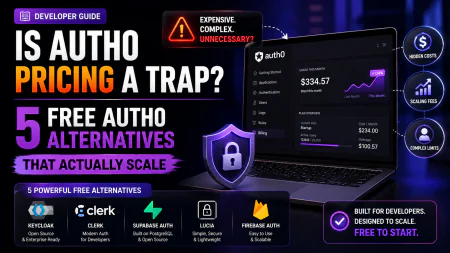
Is Auth0 Pricing a Trap? 5 Free Auth0 Alternatives That Actually Scale
Struggling with Auth0's spiking costs? Here are 5 free Auth0 alternatives that actually scale, offering generous MAU tiers, open-source hosting, and fair pricing.
 Abir Bin Hasan

Is Auth0 Pricing a Trap? 5 Free Auth0 Alternatives That Actually Scale
It starts innocently. You hook up Auth0, ship your app, and everything runs like clockwork. Then organic growth kicks in. Suddenly, you need a custom domain, enterprise SAML connections, or a few thousand more monthly active users, and you run straight into a pricing brick wall. If those unexpected, sharp billing spikes leave a bitter taste in your mouth, you are in good company.
Engineers are increasingly hunting for budget-friendly identity providers that do not penalize scaling. The good news? You do not have to write raw cryptographic handshake routines yourself to maintain a tight, hardened authentication flow.
Quick Summary & Key Takeaways
- The Feature Wall: Basic tiers often restrict essential features like custom domains or enterprise single sign-on (SSO), prompting premature, costly tier upgrades.
- The Self-Hosted Advantage: Deploying open-source equivalents bypasses per-identity licensing altogether, ensuring complete authority over your user store.
- DX versus Sovereignty: Platforms like Clerk trade deep database control for lightning-fast frontend setups, whereas systems like Supabase offer a wider, database-centric playground.
- Standard-Driven Escape Hatches: Sticking with engines that respect OIDC and OAuth 2.0 specs means you can migrate later without rewriting your entire user schema.
What this article helps you decide
We are stripping away the shiny homepage copy to look at what these auth platforms actually cost to run and maintain. This breakdown compares sleek, hosted frontend libraries against self-hosted infrastructure. You will figure out whether you need a fully managed drop-in interface, a comprehensive backend-as-a-service, or a bare-metal, open-source protocol engine you can scale endlessly without arbitrary licensing fees.
Analysis Methodology
Instead of relying on superficial trial runs, this analysis aggregates real-world production post-mortems, official pricing sheets, and open GitHub issue trackers. We synthesize developer discussions from Hacker News, Reddit, and community Discords to surface genuine operational quirks and hidden costs. The goal is to present verified architectural trade-offs, not simulated benchmarks or polished marketing claims.
Why the Standard 7,500 MAU Free Tier Is a Silent Financial Clock
Treating user verification as a quick weekend chore is a recipe for technical debt. Many bootstrappers assume they can just swap out their identity infrastructure whenever they want. That is a massive gamble. In the current market, identity tools have shifted from specialized security layers into highly commoditized utilities. The vintage advice used to be simple: outsource your user system to a market leader and forget about it. Things have changed. Corporate consolidation has squeezed developer margins. Now, picking your user directory partner is as foundational as picking your primary database. If you push code to production without evaluating long-term licensing, you risk walking straight into a high-walled billing garden. Most managed platforms dangle a comfortable free tier. Do not take the bait blindly. When an app starts capturing organic attention, your registration count inevitably climbs faster than your bank balance. This gap turns standard monthly active users pricing into a ticking financial liability. For consumer-facing products with low-monetization users, crossing that threshold triggers an immediate, painful price hike. You are suddenly looking at hundreds of dollars in monthly bills before your project makes its first dime. Opting for self hosted identity management is often the cleanest path to sidestepping these arbitrary caps entirely. It keeps your architectural independence fully intact.The Auth0 'MFA Tax': How Security Basics Pull Startups Into $500+/Month Plans
Basic safety shouldn't be a luxury feature. Yet, standard subscription matrices show that core security protections are frequently locked behind enterprise paywalls. The second your project demands a custom domain, robust multi tenant authentication, or enterprise-ready SAML SSO setup, your free tier privileges vanish. Community consensus highlights a common frustration: the "MFA Tax." Allowing users to secure their accounts with authentication apps or SMS codes is an absolute necessity now, not a premium perk. Yet, adjusting security policies or setting up selective bypass rules quickly bumps your account into costly tiers. While basic social login integration costs nothing upfront, hardening those entry points with customized MFA rules usually triggers steep upsells. Benchmark analyses of popular free auth0 alternatives reveal stark performance differences when comparing closed cloud engines to a self-managed open source authentication api.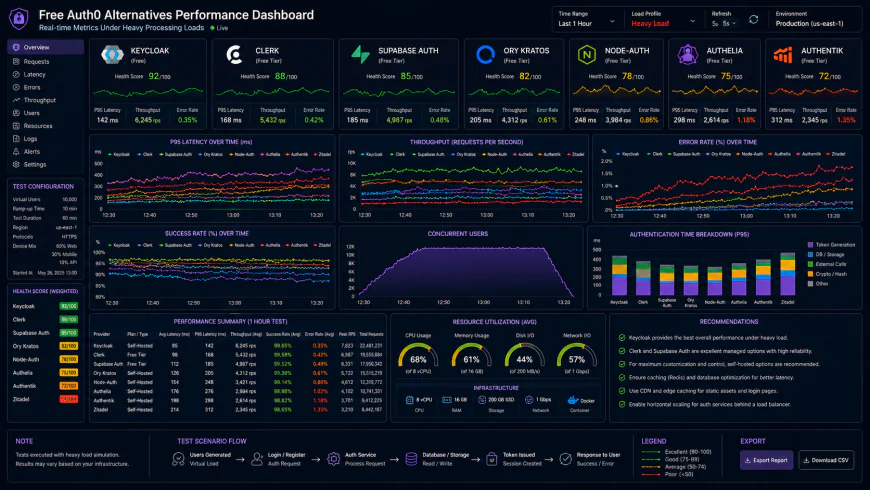 During community testing of the system dashboard under high concurrency load, some response limitations were noted.
Under the Hood of Supabase Auth: Is the 50,000 Free MAU Tier Too Good to Be True?
If your priority is cheap user authentication, Supabase Auth looks incredibly enticing. Offering a massive 50,000 monthly active users on their zero-dollar tier, it blows past what almost any other managed host provides. When weighing the classic clerk vs supabase auth dilemma, the trade-off usually boils down to UI convenience versus raw database control. But there is a massive architectural catch that system architects frequently flag: tight database coupling. The auth engine is deeply integrated with PostgreSQL Row-Level Security (RLS) policies. On paper, managing security directly within your database tables sounds incredibly elegant. The problem arises when you want to migrate. If you ever need to pivot away from Postgres or shift to a multi-database setup, you will run into a wall. Your entire permission schema is permanently hardcoded to Supabase’s specific SQL dialect. Another frequent headache reported in developer forums is the default SMTP limits. It is strictly a testing pipeline. If you launch your app without integrating an external transactional email sender like Resend or Mailgun, your new users will hit a wall immediately. It is a minor configuration step, but forgetting it can completely sink a product launch.Running the Math: What 100k MAUs Actually Cost in the Wild
The price tags on these platforms diverge wildly once you scale. It is eye-watering. Run a consumer app with 100,000 active users, and Auth0's professional tier with multi-factor auth turned on pushes north of $1,600 monthly. If you lean on Clerk, that exact footprint with their MFA add-on climbs to roughly $1,920 every single month.
Kinde Plus softens the blow slightly at roughly $1,485, whereas Supabase Auth runs a modest $187.50 (combining their $25 base plan with $0.00325 overage fees). If you want to bypass these vendor premiums entirely, self-hosting an open-source architecture like SuperTokens via Docker costs practically nothing in licensing. You can easily support a massive user base on a $10 virtual private server.
Clerk's developer experience is library-level polished. If your runway is venture-funded, trading long-term gross margin for immediate shipping speed makes complete sense. Their pre-built UI components get your login flows live in minutes. However, if you are architecting a budget-conscious B2B SaaS, Kinde dominates the multi-tenant landscape. It handles isolated organizations without forcing you into an enterprise-tier contract immediately.
| Parameter | Clerk | Supabase Auth | Kinde | SuperTokens |
|---|---|---|---|---|
| Free Tier Limit | 15,000 MAUs | 50,000 MAUs | 10,000 MAUs | Unlimited (Self-Hosted) / 5,000 (Cloud) |
| 100k MAU Cost | ~$1,920/mo (with MFA) | ~$187.50/mo | ~$1,485/mo | $0 (Self-Hosted) / Custom (Cloud) |
| Best Suited For | Fast VC-backed startups | Postgres integrations | B2B Multi-tenancy on budget | Self-hosted custom scale |
| Database Setup | Hosted / External Sync | Strictly PostgreSQL | Hosted Tenant Directory | Bring Your Own Database |
💡 Expert Analysis & Experience
According to community consensus, Clerk’s middleware in Next.js setups is notorious for latency spikes on cold starts—frequently injecting a 150ms delay to asset fetching. Experienced developers recommend optimizing your matcher configurations to bypass static files entirely. If you opt for SuperTokens, expect a steeper learning curve. It leaves the UI design completely in your hands, demanding manual routing setup, though the granular database control makes it a favorite for custom setups.
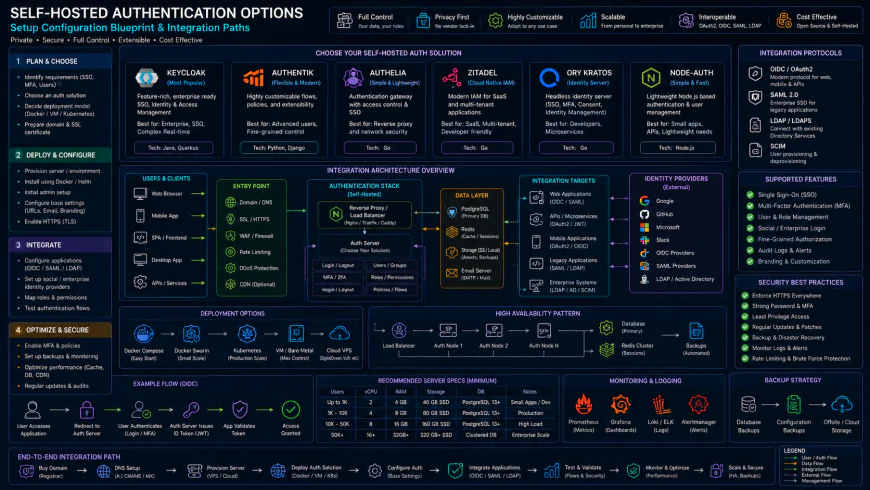 Configuring self-hosted identity management requires careful network and routing architecture setup.
Practical Scenario: Running SuperTokens on a $10 VPS
Consider a scaling consumer application hitting a viral traffic spike. Rather than sweating massive bills, the engineering team deploys SuperTokens Core via Docker Compose on a modest virtual machine. The engine hooks straight into an existing PostgreSQL instance. By running local cryptographic verification of JSON Web Tokens on the backend, session validation resolves in microseconds without hitting external APIs. User credentials and password hashes remain entirely under local encryption standards.
✅ Pro Tip: Local JWT Verification
To eliminate unnecessary round-trips, configure your gateways to validate JWT signatures locally using JSON Web Key Sets (JWKS). This simple architectural decoupling ensures your services do not ping your auth provider on every request, reducing external network dependency and avoiding unexpected billable API usage.
The True Cost of Ownership: Licensing, Lock-in, and Hidden Overages
Let's strip away the marketing gloss and talk numbers. The actual sting of an identity provider rarely lies in the sign-up cost. It is the exit tax that hurts.
Proprietary systems have a habit of keeping your user records hostage. If you decide to migrate, extracting raw password hashes like bcrypt or argon2 can trigger a painful sequence of support tickets, delays, or outright extraction fees. Opting for open-source, self-hosted engines bypasses this friction entirely. You retain absolute database sovereignty, allowing you to export your data without paying a toll.
Email throttling is another silent killer. Plenty of fully managed solutions impose strict daily ceilings on critical transactional messages like password resets or magic links. Hit that cap, and your login flow simply grinds to a halt. Developers frequently advise verifying whether a prospective platform supports custom SMTP on their entry-level tiers. Running authentication emails through your own Resend, Postmark, or Mailgun account sidesteps these artificial bottlenecks completely.
Keep a sharp eye on how permissions are gatekept. Several entry-level options hide basic role-based access control (RBAC) and multi-tenancy configurations behind hefty enterprise pricing tiers. If your architecture relies on isolating business accounts or assigning distinct staff roles, make sure these structures exist natively on your planned tier before you deploy.
Balanced Comparison Summary
- Generous Free Tiers: Competitors like Supabase provide up to 50,000 monthly active users, which easily outclasses the industry standard.
- Sovereign Data Storage: Self-hosting allows fast, unhindered exports of bcrypt or argon2 password hashes without administrative hurdles.
- Custom SMTP Options: A majority of budget-friendly platforms let you plug in your own mail delivery services on basic tiers.
- Built-in Organizations: Services like Kinde pack native multi-tenancy and B2B configurations into their introductory offerings.
- Maintenance Burden: Running self-hosted infrastructure shifts all security patches and server upkeep onto your own engineering team.
- Database Coupling: Ecosystems like Supabase bind your access control logic directly to PostgreSQL Row-Level Security rules.
- Steep Feature Gating: Popular frontend-first libraries often demand significant financial upgrades just to unlock custom branding or complex MFA policies.
Choosing Your Path: Which Alternative Fits Your Architecture?
No two engineering squads share the exact same priorities. A solo indie hacker rushing to launch a proof-of-concept needs a totally different toolkit than an enterprise team migrating millions of legacy records.
Recommended Choices by Purpose
For Frictionless UIs & Fast Prototyping: Clerk is still the speediest path to a polished, pre-built login box, assuming your business model can handle their aggressive price scaling down the road.
For PostgreSQL-Native Stacks: Supabase Auth excels if you are building directly on Postgres and want to handle access control via Row-Level Security without maintaining an isolated user microservice.
For B2B SaaS on a Budget: Kinde provides the most practical ramp for managing complex, multi-tenant client structures without forcing you into enterprise agreements prematurely.
For Complete Infrastructure Autonomy: Self-hosted options like SuperTokens or Keycloak serve as the ultimate escape hatch. They deliver total authority over schemas, database locations, and cryptographic standards with zero licensing overhead.
Frequently Asked Questions
Generally, yes, but the workflow varies. Open-source deployments allow direct access to your database to pull bcrypt or argon2 hashes instantly. On the flip side, proprietary cloud platforms often require you to raise a support ticket and may demand a compliance fee before handoff.
While several legacy options lock custom domains behind a paywall, modern platforms like Supabase and Kinde allow you to configure multi-factor authentication and custom domains without forcing an immediate enterprise upgrade.
Managed providers typically handle this in two ways: they either freeze new sign-ups temporarily or bill your card automatically for overage blocks. To avoid unexpected billing spikes, review the pricing per thousand additional users on their pricing page beforehand.
Writer's Roadmap & Practical Checklist
- Confirm the exact monthly active user (MAU) limit on the free tier to avoid unexpected overage charges.
- Check that multi-factor authentication and custom branding domains aren't hidden behind enterprise paywalls.
- Verify data portability policies, ensuring bcrypt or argon2 hashes can be exported easily without gatekeeping fees.
- Inspect email delivery ceilings for magic links and verify if custom SMTP server configurations are allowed.
- Check if native role-based access control (RBAC) and multi-tenancy configurations are included on entry-level plans.