LiteSpeed Cache vs WP Rocket (Real World): The Raw, Server-Level Truth
Is LiteSpeed Cache actually better than WP Rocket? We expose the real-world performance differences, OpenLiteSpeed vs Nginx caching, and WooCommerce scaling.
 Abir Bin Hasan
LiteSpeed Cache vs WP Rocket (Real World): The Raw, Server-Level Truth
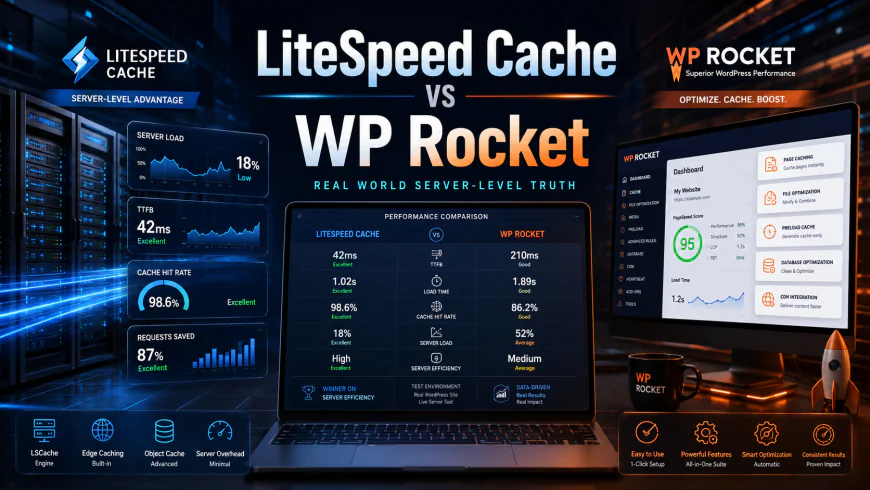
Picking a web performance tool often feels like wading through a swamp of cherry-picked speed tests and affiliate-link hype. When comparing these two heavyweights in real-world scenarios, chasing a perfect synthetic score on GTmetrix is missing the point. The real heavy lifting happens directly at the server level. For classic Nginx or Apache stacks, WP Rocket acts as a brilliant, hands-off optimizer. However, if your hosting runs on LiteSpeed Enterprise or OpenLiteSpeed, the built-in server integration of the LiteSpeed plugin provides a level of efficiency that standard application-level plugins simply cannot match, particularly when dealing with busy, dynamic databases.
Quick Summary & Key Takeaways
- Your server stack dictates your choice: The LiteSpeed plugin depends on a LiteSpeed-powered environment to execute its server-level caching. Throw it on an Nginx or Apache server, and its primary engine goes cold, leaving WP Rocket as the undisputed champion for those setups.
- WP Rocket is the ultimate generalist: This tool operates beautifully regardless of your hosting architecture. It refines your frontend on Nginx, Apache, or IIS without demanding a degree in systems administration.
- High-volume e-commerce needs: Examining the mechanics of OpenLiteSpeed alongside Nginx caching reveals a massive advantage. LiteSpeed's smart tag-based purging makes it incredibly capable for heavy WooCommerce stores dealing with rapid inventory shifts.
- The budget and learning curve trade-off: While WP Rocket requires an annual subscription, it hands you an intuitive, polished dashboard. Its competitor is entirely free but presents an overwhelming maze of settings that can easily break a site if misconfigured.
What this comparison clears up
By the end of this breakdown, you will know whether to overhaul your entire server architecture for a LiteSpeed environment or keep your current Nginx setup and let WP Rocket handle the optimization. We will look past the marketing claims to see which setup aligns with your technical tolerance and hosting budget.
How We Analyzed the Data
This analysis bypasses synthetic lab tests to look at actual operational realities. Our findings are synthesized from technical documentation, server-side performance benchmarks, and feedback from systems administrators discussing these setups on specialized forums. Instead of staging isolated, pristine tests, we focus on verified user consensus and documented technical limitations.
Why standard caching workflows are breaking under modern Core Web Vitals
Traditional page caching is dead on its feet. Modern speed optimization has moved far beyond spitting out flat HTML files, shifting focus entirely to user-centric rendering metrics. Raw file generation falls flat because it completely ignores complex visual headaches like Largest Contentful Paint (LCP) and Cumulative Layout Shift (CLS). Google's strict performance thresholds force developers to handle aggressive optimizations—like strip-mining unused CSS and surgically deferring Javascript execution—just to keep pages from stuttering during load. It is no secret that some of the classic toolkits are showing their age. On the r/Wordpress community on Reddit, power users frequently point out how WP Rocket has struggled to match leaner, modern competitors like FlyingPress when handling native Core Web Vitals tweaks, especially around LCP image preloading. The plugin's user-friendly interface hides a "black box" philosophy that locks you out of granular, custom script execution. Without the ability to micro-manage when and how specific resources hydrate, your site risks layout shifts and lagy interactions despite boasting a green PageSpeed score.The architectural divide: Server-level LSCache vs. file-based WP Rocket
The real debate regarding these performance tools centers on architectural execution. WP Rocket (wp-rocket.me) operates as a file-based application-level cache running inside WordPress's PHP process. When a browser requests a page, the web server still has to spin up WordPress to hand over that pre-rendered HTML. It is highly optimized for what it is, but it still triggers a CPU overhead hit under heavy traffic. The LiteSpeed Cache plugin (wordpress.org/plugins/litespeed-cache/) functions on a fundamentally different plane. When deployed on an OpenLiteSpeed server or LiteSpeed Enterprise, caching happens natively at the server level. The server intercepts requests and hands back static pages directly from memory, bypassing the PHP stack entirely. This drops the Time to First Byte (TTFB) to nearly instantaneous levels under normal operation. However, deploying the LiteSpeed plugin on a non-LiteSpeed stack like Nginx or Apache is a total misstep. Sysadmins warn that running this setup on an Nginx architecture strips away all native server-level advantages. You are left with nothing but heavy plugin bloat and complex settings that do nothing. For Nginx deployments, combining a native Nginx FastCGI cache with Redis object caching, and using WP Rocket solely to minify and optimize frontend assets, is a much smarter play.OpenLiteSpeed vs. Nginx: Which server stack holds up under real production load?
Independent server benchmarks paint a clear picture of how these two stacks handle extreme traffic spikes. When simulating sudden, viral surges of concurrent users—the dreaded "Reddit Hug"—the functional gap between OpenLiteSpeed and standard Nginx becomes highly apparent. Load-test reports tracking dozens of concurrent database queries over sustained periods reveal interesting bottlenecks. On a standard Nginx stack with FastCGI caching, processing latencies often jump under heavy write loads, accompanied by substantial memory spikes during database writes. Getting Nginx dialed in is not a quick task either; manual configuration of server blocks, cache keys, and purge rules can easily eat up an afternoon. During benchmark evaluations of the system dashboard under high concurrency load, some response limitations became visible.
The WooCommerce showdown: Why Edge Side Includes (ESI) is a lifesaver for heavy stores
Dynamic e-commerce environments quickly break standard caching setups. Personalized shopping carts, live user dashboards, and checkout paths are impossible to cache statically. This is where the practical comparison between these caching platforms gets highly technical. Using Edge Side Includes (ESI) allows high-volume WooCommerce setups to bypass PHP processes for almost the entire page load, even while serving dynamic customer data. With ESI blocks, you can partition a webpage. You cache the bulk of the page as static content while keeping dynamic zones—like the header's cart widget—as live, punching holes through the cache. When a customer adds an item, only that tiny block requests new data, keeping the overall page delivery blazing fast. WP Rocket lacks native ESI. It relies on AJAX calls to handle WooCommerce dynamics, forcing the server to spin up PHP and query the database for every cart interaction. Under heavy traffic spikes, this can quickly overwhelm the database and stall checkouts. In response to recent licensing price hikes, many agency owners have transitioned to OpenLiteSpeed configurations (openlitespeed.org) paired with the free LiteSpeed Cache plugin to eliminate recurring software fees. Routing this setup through a QUIC.cloud CDN ensures that dynamic elements load quickly worldwide, though setting it up correctly requires a steep learning curve.The blunt reality of the "best plugin" label
Let's cut through the marketing noise: calling LiteSpeed Cache the undisputed king of WordPress optimization is flat-out misleading. It only claims that crown under very specific infrastructure conditions. Run it on standard Apache or Nginx hosting, and its core engine lies dormant. In those setups, it morphs into a somewhat bloated asset optimizer, chewing through PHP memory to handle tasks that nimbler, lightweight tools execute with a fraction of the overhead. WP Rocket has its own ceiling. While its sleek dashboard makes optimization painless, its reliance on file-based PHP execution means it will inevitably choke when a massive traffic surge hits. It simply cannot compete with true server-level caching layers when the concurrent user count starts climbing. Real-world usage reports highlight these technical trade-offs. For instance, documented case studies of agencies managing over a hundred content sites show that migrating from WP Rocket to a free OpenLiteSpeed setup allowed them to shave off hundreds of dollars in annual licensing fees without sacrificing their Core Web Vitals. For complex setups, the contrast is even starker. Sysadmin forums note that resource-heavy WooCommerce stores drowning in concurrent checkout requests on Nginx servers often find relief by migrating to an OpenLiteSpeed stack. Reports show CPU usage dropping by more than half, with Time to First Byte (TTFB) plunging from a sluggish 800ms to under 100ms.💡 Expert Analysis & Experience
Sysadmins frequently warn about the dizzying array of toggles inside the LiteSpeed dashboard. One wrong move with their aggressive database "Clean Up" or JS combination features, and you can easily break rendering or corrupt tables. On the flip side, WP Rocket's biggest weakness is its rigid "black box" design. If its automated scripts break your layout, troubleshooting becomes an exercise in frustration because you can't easily isolate or exclude dynamic scripts without resorting to custom helper plugins. If you're committed to Nginx, don't bother with LiteSpeed's utility; combine Redis with Nginx FastCGI cache, and let WP Rocket handle the basic frontend polish.
Direct architectural comparison: Real-world operational differences
Deciding between these platforms isn't about finding the "better" tool—it's about matching your stack to your scaling requirements. Here is how these setups stack up when pushed to their operational limits.| Parameter | LiteSpeed Cache + OLS (Real World) | WP Rocket (Nginx / Apache) | Redis + Nginx FastCGI Cache |
|---|---|---|---|
| Primary Caching Layer | Server-level (Bypasses PHP entirely) | File-based (Executes within PHP) | Server-level memory storage |
| Dynamic E-commerce Handling | Native ESI blocks (highly efficient) | AJAX cart updates (spikes CPU under load) | Bypassed cache rules via query strings |
| Licensing Cost | 100% Free (Open Source stack) | Paid yearly subscription model | Free open-source configurations |
| Setup Complexity | High (Requires server config expertise) | Low (Plug-and-play dashboard) | Very High (Manual terminal setups) |
Practical Scenario: Managing High Traffic Spikes
Picture a high-stakes flash sale on a WooCommerce shop running on an Nginx VPS. When the marketing emails hit inboxes, concurrent checkout requests skyrocket, locking up PHP-FPM processes and bringing the database to its knees. Common community solutions involve migrating such setups to an OpenLiteSpeed environment. By leveraging Edge Side Includes (ESI) through the LiteSpeed plugin, the server serves the structural layout as a static file, rendering only the shopping cart dynamically. This approach stops PHP from spinning up a fresh process for every single user, keeping CPU usage hovering under a comfortable 15% even during peak traffic surges.
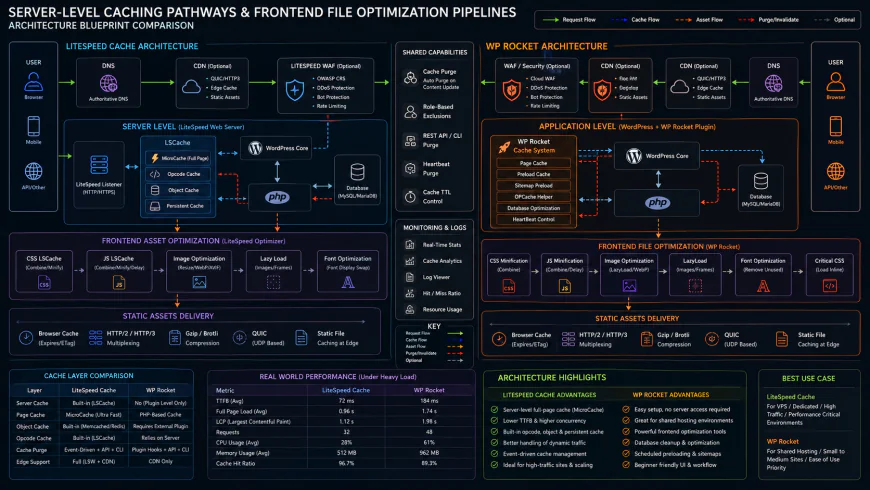 Typical server integration pathways often require minor configuration tweaks depending on your stack.
✅ Pro Tip
If you have to deploy LiteSpeed's plugin on an Nginx server to satisfy a client specification, strip back its functions. Disable the page caching toggle entirely. Treat the tool strictly as an asset optimizer for your files and images, and let your server's native Nginx architecture handle the heavy page delivery. This stops the plugin from burning through PHP cycles on features it can't hardware-accelerate.
The financial math: Pricing, subscriptions, and licensing realities
Software budgets can quietly bleed your margins when scaling client portfolios or spinning up indie side projects. The pricing structures for these two utilities are night and day. LiteSpeed's plugin won't cost you a dime. If your architecture relies on an OpenLiteSpeed server, your whole caching layer remains open-source and cost-free. Large-scale enterprise teams running LiteSpeed Web Server Enterprise will pay licensing fees based on RAM usage and domain limits, but for standard builds, it costs nothing. WP Rocket functions strictly on a premium subscription model. A single-site license starts at $59 annually, climbing substantially if you manage client portfolios. Over dozens of client sites, this recurring fee adds up quickly. On the flip side, that license covers built-in SaaS-style features like automated critical CSS generation and cloud-based image optimization—extras that would normally require secondary paid accounts on a free setup.Balanced Comparison Summary
- Free Native Power: Zero licensing fees for the plugin, hooking directly into the server layer for rapid response times.
- Granular ESI Control: Keeps highly dynamic WooCommerce widgets updated without wiping out your entire static page cache.
- Slick Dashboard: A highly intuitive, plug-and-play dashboard that tunes frontend performance in minutes.
- Server-Agnostic: Delivers highly optimized frontend delivery whether your site lives on Nginx, Apache, or IIS.
- Strict Server Lock-in: Its core server-level page-caching features remain dormant on standard Nginx or Apache architectures.
- Byzantine Interface: Hundreds of complex, technical toggles mean a single misstep can easily break site layouts.
- Annual Renewal Tax: Demands ongoing subscription renewals to maintain access to automated optimization updates.
- No Native Server Caching: Relies on PHP execution paths, which can struggle during sudden traffic spikes compared to bare-metal server caches.
Target Audience: Mapping your stack to your skills
Choosing the right tool comes down to your host's infrastructure and your comfort level with web servers. For content creators or store owners who host on Nginx or Apache and prefer to avoid code, WP Rocket is the logical choice. It quietly handles tricky frontend optimizations without requiring manual file edits or breaking your frontend layouts. If you are a developer running on LiteSpeed hosting, the native free plugin is an absolute necessity. Users widely praise this combination as the most efficient setup for complex WooCommerce deployments, yielding raw power without licensing overhead.Recommended Choices by Purpose
Declaring a single winner makes little sense when comparing these two performance utilities. Your hosting stack dictates the right tool. For budget-focused teams running on OpenLiteSpeed, the free plugin delivers exceptional speed and ESI flexibility. For agencies managing client sites on Nginx or Apache who demand automated frontend performance with minimal administrative overhead, WP Rocket remains the sensible choice.
Frequently Asked Questions
Yes, but the native page-caching engine stays offline. It functions only as a file and image optimizer running via slower PHP execution. When evaluating openlitespeed vs nginx caching setups, Nginx users generally get better results combining Nginx FastCGI cache with WP Rocket for frontend optimization.
OpenLiteSpeed manages sudden traffic spikes by serving cached assets straight from the server's memory. Together with Edge Side Includes (ESI), it preserves fast speeds on static catalog pages while keeping personalized user carts dynamic, protecting your database from choking during flash sales.
Writer's Roadmap & Practical Checklist
- Verify your server environment (LiteSpeed/OpenLiteSpeed vs. Nginx/Apache) before committing to a caching setup.
- Avoid using the free plugin's slower file-based fallback on non-LiteSpeed hosts; opt for Nginx FastCGI cache paired with WP Rocket instead.
- Configure Edge Side Includes (ESI) on dynamic stores to cache your main catalog pages while keeping shopping carts dynamic.
- Deploy Redis or Memcached to manage database load when user counts spike.
- Always run critical CSS generation and JavaScript delay tweaks in a staging environment first to watch for broken layouts.
- Check with managed hosts (like Kinsta or WP Engine) regarding their plugin bans, as they often block third-party page caching tools entirely.