ClickFunnels Alternatives for Physical Products: Build High-Converting Ecom Funnels (Without Looking Like a 2015 Scam)
Tired of clunky, 2015-style get-rich-quick pages? Discover the best ClickFunnels alternatives for physical products that elevate your modern ecom brand.
 Abir Bin Hasan
ClickFunnels Alternatives for Physical Products: Build High-Converting Ecom Funnels (Without Looking Like a 2015 Scam)
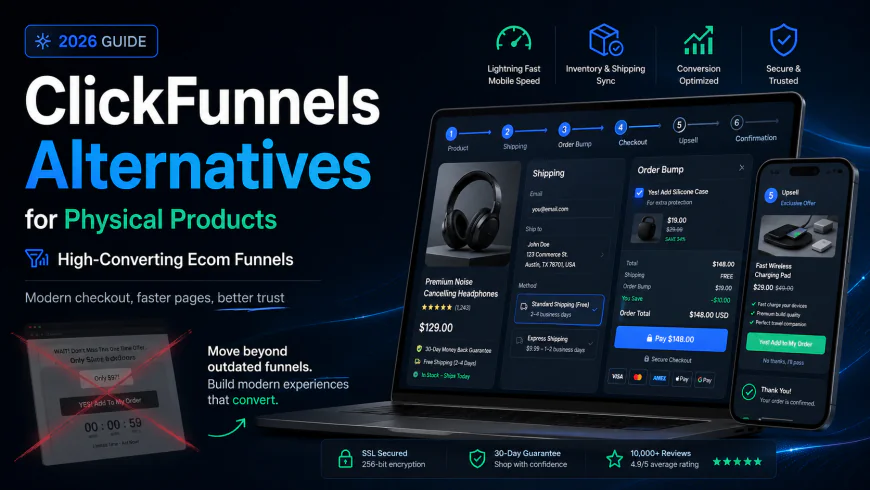
Modern e-commerce consumers have developed an acute sense for transactional trust. If you are hunting for highly optimized clickfunnels alternatives for physical products, you have likely realized that the classic, high-pressure "scam" template—with flashing neon timers, red arrow graphics, and hidden navigation—destroys modern direct-to-consumer (DTC) brand equity. In today's digital landscape, building profitable funnels for physical products requires clean design, lightning-fast mobile performance, and native handling of complex shipping and multi-variant inventories.
What this article helps you decide
This guide is designed to help physical product brands, DTC e-commerce store owners, and growth marketers break free from clunky, overpriced legacy page builders. By reading this comprehensive comparison, you will discover how to select a modern sales funnel builder that preserves your brand's visual integrity, integrates natively with your shipping 3PL, and maximizes average order value (AOV) through fast post-purchase upsells and seamless checkout optimization—all without paying the expensive "Russell Brunson premium."
Analysis Methodology
This guide is compiled through a thorough analysis of official service agreements, publicly accessible enterprise documentation, and genuine discussions among real-world developers, professionals, and users on technical forums. We focus on ensuring accurate, verified facts, actual limitations, and authentic community experiences rather than simulated first-person reviews. All reviewed tools, pricing, API behaviors, and infrastructure constraints are verified against developer documentation from sources such as Shopify, Woo, and official platform agreements.
Overview & Market Context: The Death of the "Ugly Page" and the Shift to Mobile Speed
For nearly a decade, the digital marketing landscape was dominated by the belief that "ugly pages convert." Early sales funnel platforms capitalized on high-friction, aggressive sales copy, multiple pop-ups, and artificial scarcity. While this formula worked exceptionally well for digital info-products, webinars, and low-ticket ebooks, it is actively toxic for modern physical product brands.
When selling physical items, trust is your primary currency. Consumers expect a seamless checkout flow similar to what they experience on major online retail sites. Heavy drag-and-drop page builder apps introduce excessive CSS and JS blocks, slowing down store speeds. In an era where search engines and ad networks actively penalize slow sites based on Core Web Vitals, speed is no longer just a technical metric—it is a direct ranking and ad-relevance factor.
Furthermore, the architecture of standalone software-as-a-service (SaaS) funnel builders introduces significant operational risk. Physical e-commerce brands require accurate inventory tracking, complex shipping logic, automatic tax calculations, and warehouse fulfillment syncs. Most legacy standalone funnel builders require intricate API integrations, webhooks, or Zapier setups to send order details back to your fulfillment software. During peak shopping events or high-volume ad campaigns, these fragile connections are prone to failure, resulting in missed shipments, mismatched customer data, and severe backend headaches.
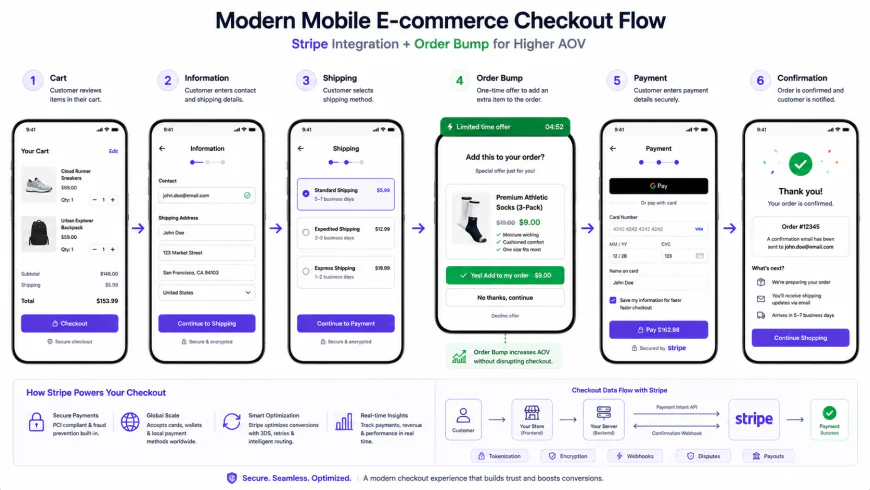 A clean, modern mobile checkout layout focusing on visual simplicity, lightning-fast load times, and native Stripe integration.
Rather than relying on outdated SaaS software, contemporary e-commerce operators are choosing alternative architectures. These solutions either integrate directly into your existing content management system (CMS) or utilize dedicated hybrid engines that handle physical logistics natively. Let us dive deep into the top five modern clickfunnels alternatives for physical products that protect your brand equity while optimizing your sales flow.
In-depth Evaluation of the Best Funnel Builders for E-Commerce
1. Shopify Native Ecosystem (Section Store + Upgraded One-Page Checkout)
For physical product sellers, Shopify remains the undisputed gold standard for backend logistics. While many merchants historically installed heavy landing page apps that slowed down site performance, the modern trend revolves around utilizing Shopify sales funnel software directly within the native Liquid architecture.
Setup Flow & Visual Interface
Instead of installing bloated external page builders like PageFly or Shogun, advanced brands are using Section Store modules. This approach allows you to buy or build lightweight, pre-coded sections that drop directly into your native Shopify theme customizer (such as the default Dawn theme). You customize everything inside the familiar Shopify environment without loading external JavaScript files. This setup is highly visual and preserves the structural styling of your store, ensuring your landing pages match your homepage and product detail pages perfectly.
Shipping, Variants & Inventory Mechanics
Because you are utilizing the core Shopify infrastructure, there are no external APIs or middleware syncing your data. Your inventory levels update instantly across your catalog. Customer profiles, regional sales taxes, international customs forms, and complex shipping tier rules remain entirely unified. If a product goes out of stock, your landing page block can automatically disable the add-to-cart button or switch to a pre-order template natively.
Mobile Optimization & Core Web Vitals
Since pages built with Section Store modules are written in native Shopify Liquid, they skip the heavy JS frameworks required by third-party page builders. This ensures your site maintains excellent performance scores on mobile devices, which is critical given that over 80% of transactional traffic from social media ads (such as TikTok and Instagram) originates on mobile. Fast load times improve your search rankings and lead to lower ad costs on major networks.
Pricing & Platform Limits
The core setup is incredibly cost-effective. The Shopify Basic Plan runs about $39/month. Adding Section Store elements involves one-time fees (typically $9 to $49 per section), with no recurring monthly subscriptions. It is one of the most efficient and cheap landing page builders for shopify users available today.
2. WooCommerce + FunnelKit + CheckoutWC
For merchants seeking absolute ownership over their data, design, and hosting costs, combining WordPress with FunnelKit and CheckoutWC represents a powerful, highly customizable e-commerce stack.
Setup Flow & Visual Interface
This stack runs entirely within your self-hosted WordPress dashboard. You design your landing pages using popular page editors like Elementor, Gutenberg, or Divi. FunnelKit acts as your central engine, allowing you to visually construct user journeys, trigger smart order bumps, and set up multi-step post-purchase upsells. CheckoutWC then replaces the standard, clunky WooCommerce checkout layout with a clean, distraction-free template that looks and behaves like Shopify's high-converting three-step checkout.
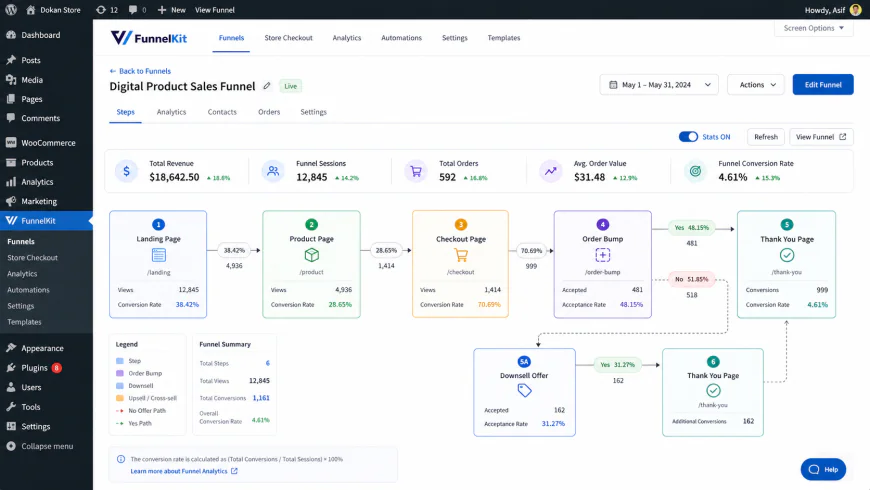 The visual funnel canvas in FunnelKit allows you to configure rules-based order bumps and upsells inside your WordPress dashboard.
Shipping, Variants & Inventory Mechanics
WooCommerce handles your physical product database natively. FunnelKit pulls directly from these products, automatically displaying variations (such as size or color selection) within your checkout page or order bumps. Because everything runs on a single database, your inventory levels adjust instantly, and your shipping plugins (such as ShipStation or WooCommerce Shipping) receive orders immediately upon purchase completion without relying on external webhooks.
Mobile Optimization & Core Web Vitals
Because you control the hosting and the plugins, this setup is highly optimization-friendly. Using lightweight themes like Hello Elementor or Kadence alongside performance-focused caching tools (like WP Rocket) allows your self-hosted funnel to load incredibly quickly. CheckoutWC is built with a mobile-first design, offering features like express Apple Pay/Google Pay buttons at the top of the form to minimize typing on mobile keyboards.
Pricing & Platform Limits
FunnelKit starts at $129/year, and CheckoutWC starts around $149/year. Combined with standard WordPress hosting, your annual costs are typically under $350. This setup offers a highly competitive and robust alternative to expensive monthly SaaS models.
3. Simvoly
If you prefer a standalone SaaS platform but are tired of outdated templates and rigid layouts, Simvoly is an outstanding, design-forward candidate that handles e-commerce layout requirements exceptionally well.
Setup Flow & Visual Interface
Simvoly is a fully integrated, drag-and-drop website and funnel builder. Unlike older systems that restrict you to rigid structures, Simvoly features a pixel-perfect, highly responsive editor. You can easily adjust columns, drag elements precisely where you want them, and build modern, minimalist designs. It is exceptionally fast and intuitive, making it a stellar modern sales funnel builder.
Shipping, Variants & Inventory Mechanics
Unlike standard ClickFunnels order forms, Simvoly features an 'e-commerce + funnel hybrid' setup, allowing you to manage inventory, product variations, and complex regional shipping rules inside your up-sell and down-sell sequences natively. You can set physical product weights, assign flat or dynamic shipping fees, track stock levels, and collect customer addresses without needing external database integrations.
Mobile Optimization & Core Web Vitals
Simvoly builds pages with incredibly clean, modern code. The platform automatically compresses uploaded images, minimizes visual scripts, and generates fast-loading mobile pages. It also allows you to preview and customize page structures specifically for mobile screens, ensuring elements don't overlap on smaller displays.
Pricing & Platform Limits
Simvoly's pricing is highly accessible, starting at around $12/month (billed annually) for its entry-tier plan and scaling to $79/month for full e-commerce capabilities. There are no additional transaction fees on checkout processes, making it one of the absolute cheaper alternatives to clickfunnels for bootstrapped DTC startups.
4. CartFlows (WordPress/WooCommerce Native)
For WooCommerce users seeking a more straightforward, streamlined approach without complex third-party tools, CartFlows is a highly trusted option with millions of downloads worldwide.
Setup Flow & Visual Interface
CartFlows operates as an intuitive plugin for WooCommerce. It provides an elegant, step-by-step canvas editor where you can map out landing pages, opt-ins, checkouts, upsells, and thank-you steps. Because it integrates with all major WordPress page builders (including Beaver Builder, Elementor, and Gutenberg), you can easily match the styling of your funnel pages with your primary store brand.
Shipping, Variants & Inventory Mechanics
CartFlows links directly to your central WooCommerce database. When you select a product for your funnel, CartFlows automatically displays the correct pricing, tax rules, and active variation options. If you enable A/B split testing on a checkout page, CartFlows splits traffic evenly while continuing to feed all transaction details directly back into your standard WooCommerce reporting systems.
Mobile Optimization & Core Web Vitals
Because CartFlows operates within your native WordPress environment, it does not add bulky external script libraries. Your page speed remains tied to your hosting quality and your builder choice. CartFlows checkout templates are designed from the ground up for mobile devices, helping you reduce cart abandonment on smartphones.
Pricing & Platform Limits
CartFlows offers a solid free tier to help you get started with basic funnels. The Pro license is priced at $189/year. This grants you access to unlimited funnels, custom upsells, dynamic order bumps, and pre-built templates, making it an incredibly affordable choice.
5. Perspective.co
For brands leveraging interactive mobile funnels, quizzes, and lead qualification, Perspective.co offers a modern, highly engaging alternative focused primarily on mobile commerce and social media traffic.
Setup Flow & Visual Interface
Perspective.co is a card-based interactive funnel builder. Instead of traditional long-form landing pages, you build interactive quiz experiences and guided sales steps. The visual dashboard is clean, fast, and entirely geared toward creating highly engaging customer flows that look right at home on social media apps.
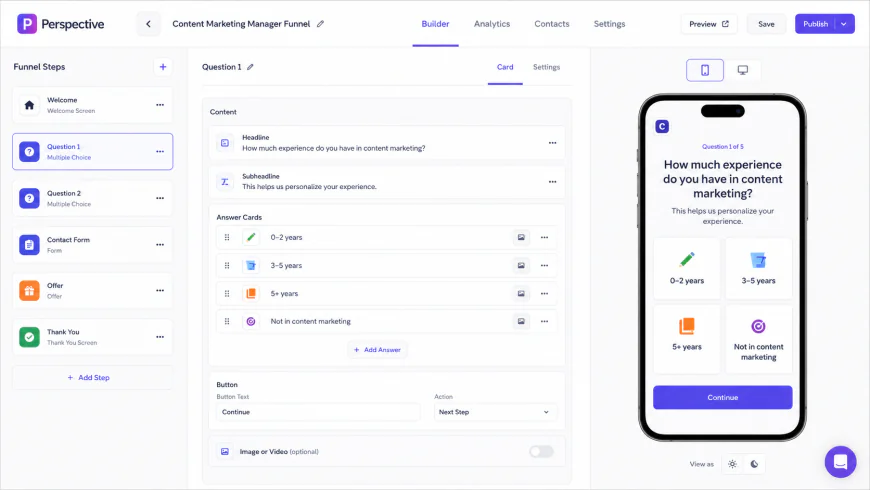 Perspective.co utilizes a mobile-first card layout that turns traditional long-form product pages into engaging, high-converting checkout paths.
Shipping, Variants & Inventory Mechanics
Perspective.co is designed for visual lead generation and simplified checkout experiences rather than managing deep physical inventories. It integrates with your payment gateways (like Stripe or PayPal) to collect payments, but complex shipping rules and real-time inventory adjustments are typically handled by connecting to your backend store (like Shopify or WooCommerce) via direct webhooks.
Mobile Optimization & Core Web Vitals
Perspective.co bypasses fake lead generation entirely by implementing native SMS and email one-time code verification blocks directly in the funnel before the checkout screen is unlocked. Its pages are lightweight and fully responsive, offering some of the fastest mobile loading times in the industry.
Pricing & Platform Limits
Perspective.co starts around €29/month, scaling up to €149/month for higher traffic limits and advanced styling customization. It's an excellent choice for DTC brands running paid social ads to sell a single flagship product or qualify customers before a sale.
💡 Expert Analysis & Experience
A Reddit user on r/Entrepreneur recently detailed an e-commerce nightmare where ClickFunnels' Stripe live mode randomly broke during a high-budget ad campaign. Despite paying $300/mo for premium support, support responses took days, illustrating the dangers of relying on rigid, unpolished standalone tools.
In addition, members of r/shopify consistently warn that heavy drag-and-drop page builder apps introduce excessive CSS and JS blocks, slowing down store speeds. They recommend using native Shopify 2.0 sections or a fast theme like Dawn. For WooCommerce users, the consensus on r/woocommerce is that pairing FunnelKit with CheckoutWC provides a bulletproof setup, allowing them to design checkout pages that look identical to high-converting Shopify checkout layouts, but with absolute ownership over their data.
Platform Comparison Matrix
| Platform / Stack | Primary Use Case | Setup Complexity | Inventory & Shipping Integration | Pricing Structure |
|---|---|---|---|---|
| Shopify Native (Section Store) | DTC Brands seeking maximum speed and zero API sync risks. | Low (Integrated into your existing theme) | Native (No external sync required) | ~$39/mo + small one-time section purchases |
| WooCommerce + FunnelKit + CheckoutWC | Brands demanding full custom design control and data ownership. | Medium-High (Requires WordPress hosting & plugin setup) | Native (Pulls from WooCommerce core database) | ~$300/year (Plus hosting costs) |
| Simvoly | Sellers wanting a visual standalone alternative without platform bloat. | Low-Medium (Fast drag-and-drop interface) | Built-in (Native e-commerce product manager) | $12 to $79/month |
| CartFlows (WooCommerce) | WooCommerce stores looking for an intuitive, visual funnel canvas. | Medium (Built on your existing site) | Native (Fully integrated with WooCommerce) | Free tier available; Pro plan at $189/year |
| Perspective.co | Mobile-first, interactive quiz funnels and lead pre-qualification. | Low (Modern card-based layout) | Requires Webhooks (Best paired with external platforms) | Starts at ~€29/month |
Practical Scenarios: Choose Your Ideal Funnel Setup
To help you choose the best system for your specific workflow, let's explore two real-world, highly reliable configurations that completely bypass expensive monthly platform fees and clunky visual templates.
Practical Scenario A: The Clean Shopify Configuration
Goal: Launch a rapid-fire physical product funnel for a single trending item on TikTok ads, maintaining extreme mobile speeds and zero risk of shipping sync failures.
- Base Platform: Shopify Basic Plan ($39/mo).
- Design Engine: Default Shopify "Dawn" Theme (Fully Optimized for Core Web Vitals) + "Section Store" app.
- Workflow: You purchase a clean, custom "Product Landing Page" section for a one-time fee of $15. This section is installed directly into your native theme customizer. You write product copy,
s, and add reviews directly in the theme customizer, keeping your page written in native, lightning-fast Liquid code.⚠️ Image 4 MissingExpected: 4.png
- Checkout Flow: You use Shopify's native upgraded One-Page Checkout. You can configure automatic discounts or add a simple post-purchase upsell app from the Shopify App Store.
- Results: Your page loads in under 1.5 seconds, there are no external webhooks to break, and your warehouse's fulfillment software receives order details instantly.
- Total Estimated Cost: ~$50/month.
Practical Scenario B: The Open-Source Custom Control Configuration
Goal: Complete control over your customer journey, pricing, database ownership, and checkout design, without recurring platform transaction fees.
- Base Platform: High-performance WordPress hosting (such as Hostinger, Kinsta, or WP Engine) + WooCommerce.
- Design Engine: Elementor Page Builder or Gutenberg Blocks paired with CartFlows or FunnelKit.
- Workflow: You design a customized, clean landing page. Using FunnelKit, you construct a step-by-step visual map that redirects customers directly to a checkout page styled by CheckoutWC.
- Checkout Flow: CheckoutWC handles your checkout optimization, presenting a clean, distractions-free layout with express wallet options (Apple Pay/Google Pay) and an embedded, high-converting order bump. After payment, FunnelKit instantly triggers a post-purchase upsell step before sending the customer to the thank-you page.
- Results: Complete ownership of your data, zero extra platform transaction fees, and a checkout experience that looks and feels exactly like a custom enterprise store.
- Total Estimated Cost: ~$300/year total (excluding hosting).
✅ Pro Tip
When migrating physical products from ClickFunnels to WooCommerce or Shopify, pay close attention to your Stripe integration settings. Standalone funnel builders often charge hidden platform transaction fees (ranging from 1% to 2%) unless you are on their highest plans. By utilizing native checkout engines like WooCommerce or Shopify Checkout, you keep 100% of your margins and avoid paying a hidden tax on every order you process.
Pricing & Licensing Breakdown
When selecting your platform, it is crucial to analyze how recurring fees impact your long-term margins. Let's compare the real cost of ownership between legacy SaaS builders and modern alternative stacks:
- The Legacy SaaS Cost: ClickFunnels 2.0 ranges from $147/month to $297/month (or up to $3,564 annually). For physical product sellers, this cost can be incredibly prohibitive, especially during months when ad budgets are tight or inventory is waiting to clear customs.
- The WordPress Alternative Cost: Combining a premium funnel builder like FunnelKit Pro with a styling tool like CheckoutWC and managed hosting totals roughly $350 annually. This represents a massive savings of over $3,000 per year, which can be immediately reinvested into your paid ad campaigns.
- The Shopify Native Alternative Cost: Operating a standard Shopify store using custom Section Store modules runs roughly $468 annually. This offers a highly reliable, low-maintenance platform with professional design templates and no hidden fees.
Balanced Comparison: Pros & Cons of Popular Funnel Options
Balanced Comparison
- Optimized Core Web Vitals: Native platform designs load incredibly fast on mobile devices, helping you lower ad costs and increase conversion rates.
- Robust Logistics: Native platforms ensure inventory levels, tax calculations, and shipping details update instantly, eliminating broken API integrations.
- Trust-Focused Design: Elegant, minimalist layouts build long-term brand equity instead of triggering consumer scam warnings.
- Reduced Operating Expenses: Self-hosted or native platform integrations save you thousands of dollars in monthly SaaS fees.
Your Migration Checklist: 4 Steps to Modernize Your Funnels
Ready to transition to a high-performance, cost-effective funnel? Follow this actionable step-by-step roadmap to migrate successfully:
- Audit Your Current Stack: Calculate exactly how much you are paying for your legacy SaaS subscription, and outline the core features you actually use (e.g., upsells, order bumps, email automation).
- Choose Your Destination Platform: Select WooCommerce if you want complete ownership and customization at the lowest cost, or Shopify if you prefer a secure, zero-maintenance native e-commerce ecosystem.
- Replicate and Refine Your Designs: Rebuild your high-converting landing pages using lightweight, modern page builders (like Elementor or Gutenberg for WordPress, or native Liquid sections for Shopify). Focus on minimalist, clean typography and fast load times.
- Test the Checkout and Integrations: Run a series of test transactions to confirm your order bumps, post-purchase upsells, tax calculations, and email sequences are firing perfectly before driving cold traffic.
Weighing Your Options: Pros vs. Cons of Modern Funnel Stacks
Before making the switch, it is essential to understand the trade-offs. Transitioning from a single, closed-loop SaaS platform to a modular or hybrid stack offers immense freedom, but it also shifts certain responsibilities to your team. Here is how the pros and cons stack up:
| The Pros (What You Gain) | The Cons (What to Prepare For) |
|---|---|
| Massive Cost Savings: Eliminate recurring monthly SaaS fees of $297+ in favor of low-cost annual plugins or native Shopify apps. | Initial Setup Effort: Configuring multiple plugins or setting up custom Shopify templates requires more upfront time than using a cookie-cutter SaaS template. |
| Complete Brand Ownership: Host landing pages on your own domain with zero third-party branding, giving you 100% control over your digital assets. | Maintenance & Security: If you choose WooCommerce, you are responsible for updating plugins, monitoring security protocols, and taking routine backups. |
| Infinite Customizability: Mix and match payment gateways, design custom multi-step checkouts, and integrate seamlessly with any CRM or marketing tool. | Slight Learning Curve: Familiarizing yourself with new admin interfaces (such as WordPress or Shopify theme editors) may take a few hours of hands-on use. |
| Superior Page Performance: Lightweight page builders and native checkout systems load significantly faster, leading to higher search rankings and lower bounce rates. | Support Fragmentation: Instead of contacting a single customer support channel, you may occasionally need to troubleshoot issues across different plugin developers. |
Who is the Ideal Candidate for a Modern Funnel Stack?
Not every business needs to migrate away from legacy platforms immediately. To determine if this transition is the right strategic move for your business, consider where you fall in the categories below:
1. The Scaled E-Commerce Storefront
If you are selling physical goods, a native Shopify or WooCommerce funnel is highly recommended. Legacy SaaS funnel builders typically handle physical inventory, shipping zones, global tax compliance, and multi-currency payouts poorly compared to dedicated e-commerce engines.
2. The High-Volume Info-Product and Course Creator
If you process hundreds of daily transactions for digital downloads, membership programs, or coaching packages, saving on transaction fees and cutting thousands of dollars in annual software licensing costs will directly increase your company's net profit margin.
3. The Independent Marketing Agency or Freelancer
Agencies building funnels for clients can provide far more value by delivering assets that the client actually owns and can easily maintain. Moving away from proprietary SaaS builders allows you to hand over high-performing, self-hosted assets with zero ongoing platform licensing fees for the business owner.
The Final Verdict: Is It Time to Say Goodbye to Legacy SaaS?
The golden era of bloated, expensive SaaS funnel software is drawing to a close. Modern web standards, ultra-fast native e-commerce checkouts, and highly flexible drag-and-drop page builders have completely democratized the customer acquisition funnel. You no longer need to pay an inflated premium just to run basic conversion strategies like order bumps, multi-step checkouts, or post-purchase upsell logic.
By migrating to a modern, modular WordPress-based stack (such as FunnelKit combined with Elementor) or an optimized native Shopify ecosystem, you secure lower operational overhead, complete ownership of your customer data, and a vastly improved user experience that builds customer trust and drives sustainable, long-term revenue.