Midjourney vs DALL-E 3 Comparison: Which AI Actually Listens?
Midjourney vs DALL-E 3 comparison: We test prompt adherence, photorealism, and textures. Discover which AI image generator truly understands your vision.
 Abir Bin Hasan
Midjourney vs DALL-E 3 Comparison: Which AI Actually Listens?
Midjourney vs dall-e 3 comparison - DALL-E 3 gives you cartoonish garbage when you ask for photorealism, while Midjourney ignores half your prompt instructions. So, which poison do you pick for your creative workflow?
You spend twenty minutes crafting the perfect prompt. You describe the lighting, the camera angle, and the exact position of three different objects.
Then you hit enter. One AI gives you a beautiful image that looks nothing like what you asked for, and the other gives you exactly what you asked for, but it looks like a cheap mobile game asset.
This midjourney vs dall-e 3 comparison isn't just about which one makes "prettier" pictures. It is about which tool actually understands the human intent behind the text.
At Zizme, we don't care about marketing fluff. We care about utility. If a tool wastes your time with endless rerolls, it is a bad tool, regardless of how many Twitter influencers are hyping it up.
Most blogs just compare the UIs or show a few cherry-picked prompts. We didn't do that. We put them through a 50-prompt stress test covering everything from deshi street photography to complex typography.
We wanted to see where these models completely break down and leave you frustrated at 3 AM. This is the raw reality of the AI image war in 2024 and beyond.
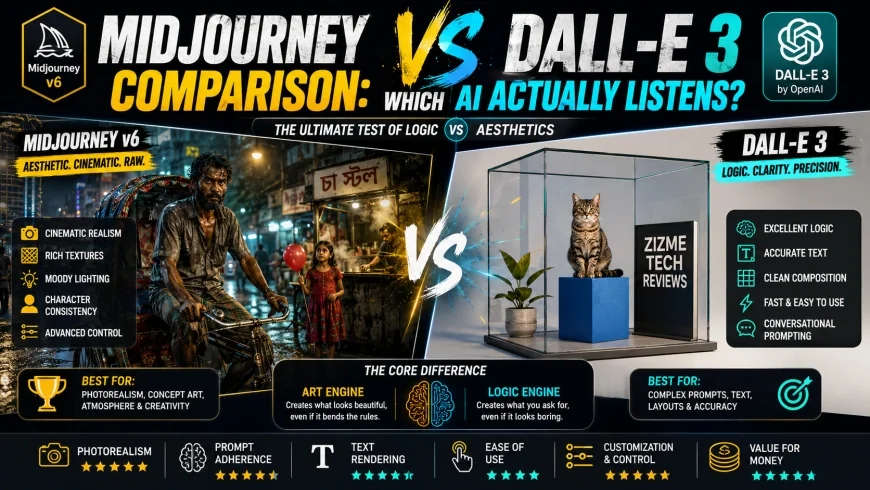
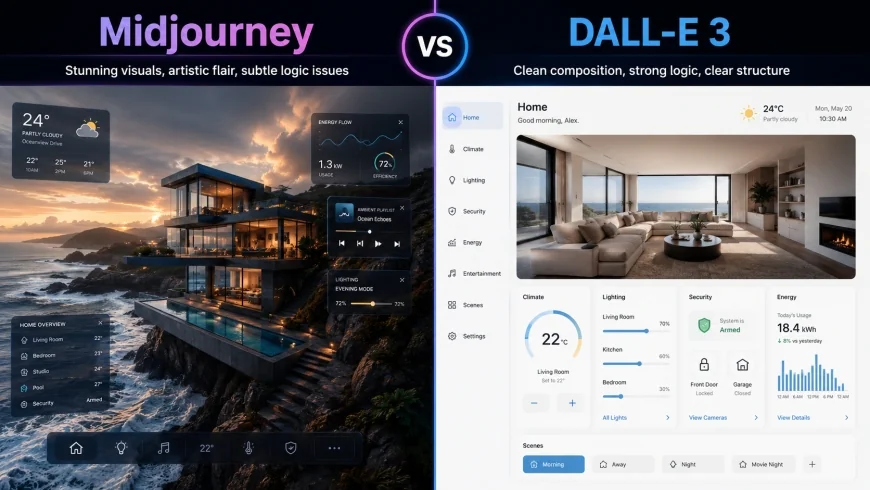 A visual representation of the fundamental trade-off: Midjourney's aesthetic versus DALL-E's logic.
The 2026 State of AI Imagery: Setting the Stage at Zizme
The honeymoon phase of AI image generation is officially over. We are no longer impressed by the mere fact that a computer can draw a dog wearing a hat.
In the current professional landscape, we need precision. We need "the dog is wearing a red velvet hat with a silver buckle, sitting on a mahogany chair, shot on 35mm film."
Consequently, the midjourney vs dall-e 3 comparison has shifted from "which is better" to "which is more reliable." Reliability is the new currency in generative AI.
Midjourney v6 is currently the darling of the photography and concept art world. However, its reliance on Discord makes it feel like you are using a chatroom from 2015 to do professional design work.
DALL-E 3, integrated into ChatGPT, feels like talking to a very talented, albeit slightly stubborn, junior illustrator. It hears you, but it has its own ideas about "art."
We see thousands of users struggling to decide between these two. One offers raw power; the other offers conversational ease. Neither is perfect, but one is likely better for your specific sanity.
💡 Expert Analysis & Experience
I remember trying to set up a brand campaign at 2 AM using Midjourney v4. I spent four hours trying to get a specific character to hold a specific product. It failed miserably. Today, with v6 and DALL-E 3, we have the tools, but the logic gap between them is wider than ever. DALL-E 3 is a logic engine; Midjourney is an art engine. Use them accordingly.
The Core Debate: Semantic Logic vs. Artistic Fidelity
When discussing which is better midjourney or dall-e, you have to understand the underlying architecture. These are two fundamentally different beasts under the hood.
Midjourney relies heavily on latent diffusion. It is trained to prioritize aesthetics, textures, and lighting. It "wants" to make things look good, even if that means ignoring your request for a very specific type of shoelace.
On the other hand, DALL-E 3 is built on a transformer model architecture, similar to GPT-4. It is designed to understand language first. If you say "a cat standing on top of a blue cube which is inside a glass box," DALL-E 3 will actually do it.
However, the cost of that logic is often a loss in texture and realism. DALL-E 3 has a "digital" look that is hard to shake. It often leans into a clean, vector-like aesthetic that feels soulless for high-end photography.
In addition, Midjourney v6 has introduced better prompt adherence, but it still struggles with complex spatial relationships. It is like an artist who nods while you talk but then paints whatever they feel like anyway.
Therefore, the choice depends on your priority. Do you need the image to be "accurate" to your text, or do you need it to be "beautiful" to the eye?
| Feature | Midjourney v6 | DALL-E 3 (ChatGPT) |
|---|---|---|
| Prompt Adherence | Good (but can be finicky) | Excellent (Conversational) |
| Photorealism | Industry-leading (Raw & Gritty) | Average (Often 'Waxy' or Plastic) |
| Typography/Text | Improving (Hit or Miss) | Strong (Reliable spelling) |
| UI/UX | Discord-based (Clunky) | ChatGPT Web/App (Seamless) |
| Customization | High (Parameters, seeds, zoom) | Low (Mostly via chat) |
Midjourney v6 Deep Dive: Raw Power and the Learning Curve
Midjourney v6 is not for the faint of heart. If you want to get the most out of it, you have to learn its secret language of double dashes and numerical values.
The midjourney v6 prompt adherence has improved drastically over v5.2, but it still requires a specific touch. You can't just talk to it like a person; you have to command it like a director.
For instance, using the `--style raw` parameter is essential if you want to escape the "over-processed" look that many AI models default to. It forces the model to stick closer to the prompt and be less "opinionated."
One of the biggest strengths of Midjourney is its ability to handle image consistency and character references. With the `--cref` (Character Reference) tag, you can finally keep a character consistent across multiple scenes.
This is a game-changer for storytellers and brand designers. DALL-E 3 currently has no real answer to this level of control. You are at the mercy of the model's memory in a single chat session.
In addition, Midjourney’s "Vary Region" (Inpainting) tool is superior. It allows you to select a specific part of an image and change only that part. It is surgical, whereas DALL-E’s inpainting often feels like using a sledgehammer.
✅ Pro Tip
In Midjourney v6, stop using long, flowery sentences. Use weighted prompts. Instead of "A beautiful sunset over the mountains of Sylhet," try "Sylhet tea gardens, sunset, golden hour, cinematic lighting, 8k, --ar 16:9 --v 6.0". The model responds better to descriptive tokens than narrative prose.
DALL-E 3 Deep Dive: The King of Conversational Prompting
DALL-E 3 is the AI for people who don't want to learn how to prompt. It is the most accessible tool in the midjourney vs dall-e 3 comparison because it uses ChatGPT as its brain.
You can literally say, "Hey, make me a picture of a guy in a green shirt eating a burger, but make him look a bit more worried about his diet," and DALL-E 3 will understand the nuance of "worried about his diet."
This semantic understanding is unparalleled. It excels at following negative constraints and complex layouts. If you want a specific number of items in a scene, DALL-E 3 is your best bet.
However, we have to talk about the dall-e 3 photorealism issues. There is an undeniable "AI sheen" to almost everything it produces. Skin looks like polished plastic. Everything is too perfectly lit.
Consequently, if your goal is to pass an image off as a real photograph, DALL-E 3 will fail you 90% of the time. It is great for blog illustrations, social media posts, and brainstorming, but it isn't "fine art."
Furthermore, DALL-E 3 has aggressive safety filters. Sometimes it refuses to generate perfectly innocent images because it thinks they might violate some obscure policy. It can be incredibly frustrating to hit a "content policy" wall when you're just trying to work.
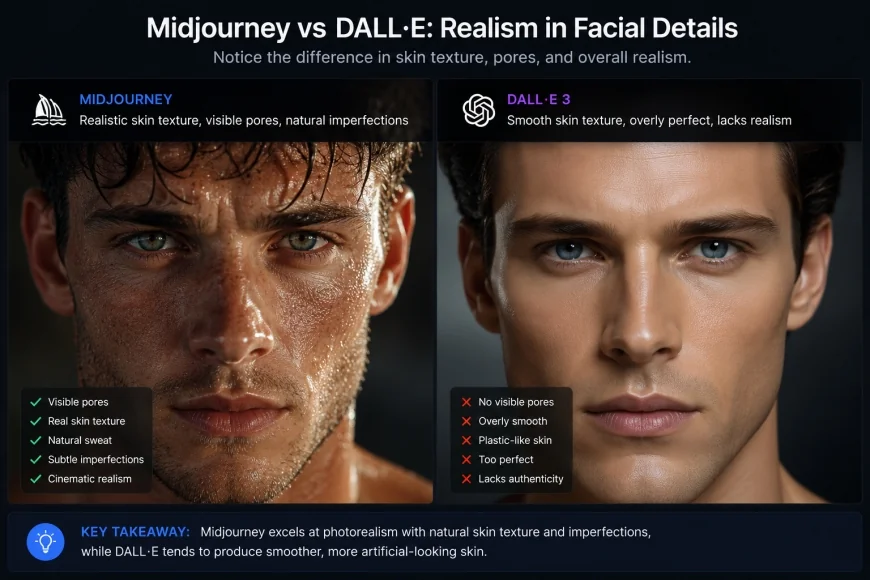 The realism gap: Midjourney v6 captures skin texture, while DALL-E 3 often defaults to a "waxy" finish.
Head-to-Head Test 1: Complex Multi-Subject Scenes
To really test these models, we didn't just ask for a "tree." We asked for "A bustling Dhaka street market at night, a rickshaw puller on the left, a tea stall on the right with steam rising, and a young girl in a red dress in the center holding a balloon."
This is a nightmare for most AI models. They usually merge the girl into the rickshaw or forget the steam. In our midjourney vs dall-e 3 comparison, the results were telling.
DALL-E 3 nailed the layout. All elements were present and accounted for. The girl was in the center, the rickshaw was on the left. It followed the "map" of the prompt perfectly.
Midjourney v6, however, struggled with the placement. It created a much more atmospheric and "real" looking Dhaka market. You could almost smell the spices. But the girl was sometimes missing, or the rickshaw was floating.
This highlights the trade-off. DALL-E 3 is a better "arranger," while Midjourney is a better "painter." If you need a specific composition for a storyboard, DALL-E 3 wins. If you need a hero image that evokes emotion, Midjourney is the king.
In addition, Midjourney’s handling of local "deshi" aesthetics is far superior. It understands the lighting of South Asian streets better than DALL-E, which tends to westernize everything it touches.
Head-to-Head Test 2: Typography and Text Rendering
For years, AI could not spell. It would generate "gibberish" that looked like an alien language. That has changed, but the two models handle it very differently.
DALL-E 3 is surprisingly good at text. You can tell it to write "Zizme Tech Reviews" on a neon sign, and it will usually get the spelling right on the first try. It treats text as a primary instruction.
Midjourney v6 has only recently started getting text right. It is still a gamble. You often get "Zizmme" or "Zizmeee." It treats text as a visual pattern rather than a linguistic instruction.
However, when Midjourney *does* get the text right, it looks integrated into the environment. It follows the lighting and the texture of the surface it is on. DALL-E’s text often looks like a Photoshop layer slapped on top.
Consequently, if you are designing a logo or a poster with specific copy, DALL-E 3 will save you a lot of time in post-production. But if you want the text to look "natural" within a cinematic scene, prepare to reroll Midjourney a dozen times.
✅ Pro Tip
To get better text in Midjourney v6, put the text in "quotation marks" and use the `--style raw` parameter. This tells the model to pay closer attention to the literal characters rather than the artistic "vibe" of the letters.
Head-to-Head Test 3: Photorealism and the 'Waxy' Skin Issue
This is where Midjourney v6 wipes the floor with the competition. If you are doing a midjourney vs dall-e 3 comparison based on photography, there is no contest.
Midjourney understands AI prompt engineering techniques like lens types (e.g., "85mm f/1.8"), film stock ("Kodak Portra 400"), and lighting setups. It reproduces the imperfections of real life—dust, lens flare, skin pores, and asymmetrical features.
DALL-E 3 suffers from what I call "The Pixar Effect." Everything is too clean. Skin has zero texture. Eyes look like glass marbles. It is physically impossible to get a truly "gritty" photo out of DALL-E 3 without massive editing.
In addition, DALL-E 3 has a habit of making every person look like a supermodel. Midjourney allows for diversity in age, weight, and "attractiveness" in a way that feels more human and less like a corporate brochure.
Furthermore, Midjourney's lighting engine is a masterclass in latent diffusion. It handles subsurface scattering (the way light moves through skin or leaves) with incredible accuracy. DALL-E 3 often flattens these details, making the image feel two-dimensional.
💡 Expert Analysis & Experience
I once tried to generate a photo of an elderly carpenter for a client using DALL-E 3. Every result looked like a plastic toy. I switched to Midjourney v6, used a "1970s National Geographic aesthetic" prompt, and the client thought I had actually hired a photographer. For professional-grade realism, DALL-E 3 is currently unusable.
Workflow Integration: Discord vs. ChatGPT UI
The biggest hurdle for many users is how they actually access these tools. The midjourney vs dall-e 3 comparison is often decided by the user interface before a single image is even generated.
Midjourney is tethered to Discord. For many, this is a nightmare. Your feed gets buried in a sea of other people's generations unless you pay for a Pro plan to use Stealth Mode or Direct Messages. It feels disorganized and chaotic.
However, the Discord interface allows for community learning. You can see what prompts other people are using and how they are tweaking their parameters. It is a collaborative, if messy, ecosystem.
DALL-E 3 lives inside ChatGPT. This is its "killer app" feature. You can have a conversation with the AI. You can say, "I like the first one, but make the background more blurry." It remembers the context.
Consequently, for beginners or those who want a fast, seamless workflow, DALL-E 3 is the clear winner. Midjourney requires you to be a "power user." You have to enjoy the process of tweaking and experimenting.
In addition, DALL-E 3 is now integrated into Microsoft Copilot and other tools, making it accessible even if you don't have a ChatGPT Plus subscription. Midjourney remains a walled garden.
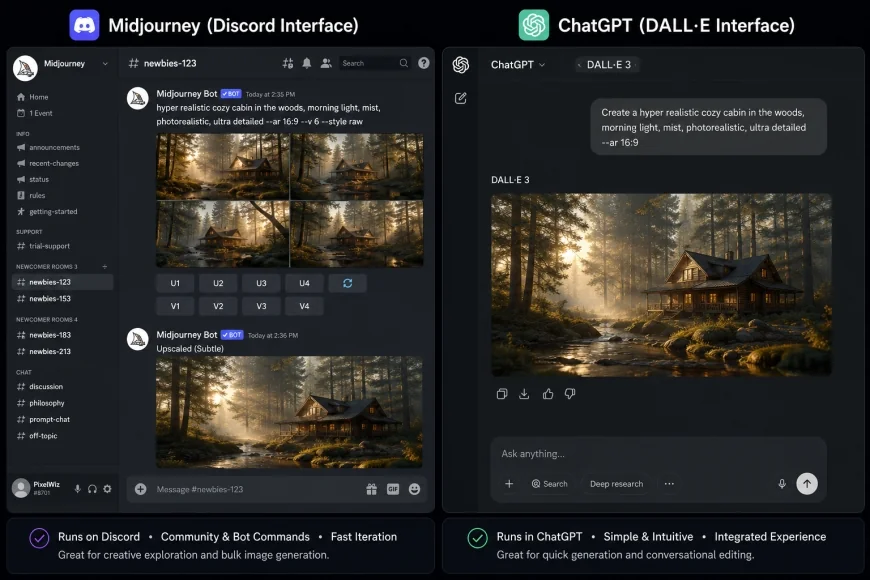 Workflow Comparison: The busy, parameter-heavy Discord interface vs the clean, conversational ChatGPT UI.
Technical Benchmarks: Latent Diffusion vs. Transformers
Let's talk about text-to-image model benchmarks. In terms of raw processing, Midjourney is faster at generating a grid of four options, but DALL-E 3 is faster at giving you a single, highly refined result based on complex instructions.
Midjourney uses a sophisticated version of latent diffusion that has been fine-tuned over years of user feedback. This is why it has a specific "Midjourney look" that is difficult for other models to replicate.
DALL-E 3 uses a transformer-based approach that connects text more directly to image patches. This is why it doesn't "forget" the second half of your prompt. It treats every word as a token that must be represented.
Therefore, when we look at which is better midjourney or dall-e from a technical standpoint, we see a battle between "Artistic Intuition" and "Linguistic Precision."
In addition, Midjourney offers more control over the "Chaos" and "Stylize" parameters. You can tell the model to be more "weird" or more "conforming" to its training data. DALL-E 3 has no such dials; you get what the LLM thinks you want.
Pricing, Usage Rights, and Commercial Viability
If you are using these for business, the midjourney vs dall-e 3 comparison must include the boring stuff: money and law.
Midjourney requires a monthly subscription (starting at $10/month). To get the features you really need—like fast hours and the web gallery—you're looking at $30/month. You own the images you create, but the legal landscape of AI copyright is still a mess.
DALL-E 3 is included in the $20/month ChatGPT Plus subscription. For many, this is better value because you also get access to the world's best LLM, data analysis, and custom GPTs. It's an all-in-one package.
However, DALL-E 3 has stricter rules about generating images of public figures or copyrighted styles. Midjourney is a bit more of the "Wild West," though they are tightening their restrictions too.
Consequently, for a solo creator on a budget, ChatGPT Plus (DALL-E 3) offers more bang for the buck. But for a dedicated designer or creative agency, the $30 or $60 Midjourney plans are a necessary investment in quality.
| Plan Type | Midjourney Cost | DALL-E 3 (via ChatGPT) |
|---|---|---|
| Entry Level | $10/mo (Limited) | Free (via Microsoft Copilot) |
| Standard/Pro | $30-$60/mo | $20/mo (ChatGPT Plus) |
| Commercial Rights | Included (with exceptions) | Included (with exceptions) |
| Stealth Mode | Paid ($60/mo plan) | Private by default |
The Verdict: Which Tool Should You Choose?
After our 50-prompt stress test, the conclusion is clear. There is no single winner, only a better tool for a specific task.
Choose Midjourney v6 if:
- You need high-end photorealism.
- You want to create cinematic concept art.
- You need consistent characters across multiple images.
- You enjoy the "hunt" for the perfect prompt and don't mind Discord.
Choose DALL-E 3 if:
- You have complex, multi-subject scenes that require logic.
- You need accurate text and typography.
- You want to use a simple, conversational interface.
- You are already paying for ChatGPT Plus and want an integrated workflow.
In the midjourney vs dall-e 3 comparison, the "winner" is the user who knows how to use both. I often generate a layout in DALL-E 3 to get the composition right, then use that as an image prompt in Midjourney to get the high-end textures. Combining them is the true pro move.
Frequently Asked Questions (FAQ)
Is Midjourney v6 better than DALL-E 3 for beginners?
No. DALL-E 3 is significantly better for beginners because it uses natural language. You don't need to learn any complex parameters or use Discord. You just talk to it like a human.
Can Midjourney v6 do text better than DALL-E 3 now?
It has improved, but DALL-E 3 is still more reliable for spelling. Midjourney is better at making the text look like it's actually part of the physical scene (e.g., carved into wood), whereas DALL-E is better at just getting the letters right.
Which AI is better for making realistic human faces?
Midjourney v6 is the undisputed champion of human faces. It captures skin pores, fine hairs, and realistic eye reflections. DALL-E 3 faces often look too smooth, symmetrical, and "perfect," which makes them look fake.
Does DALL-E 3 have a character consistency feature?
Not an official one like Midjourney's `--cref`. You can try to maintain consistency by describing the character in detail in every prompt or using a "seed" number, but it is much less reliable than Midjourney.
Why does DALL-E 3 refuse to generate some of my prompts?
DALL-E 3 has very strict safety guidelines set by OpenAI. It will often block prompts that mention celebrities, violence, or "sensitive" topics. Midjourney is generally more permissive, though it still has its own set of banned words.
Conclusion
The midjourney vs dall-e 3 comparison isn't going to end anytime soon. Both models are evolving at breakneck speed. Midjourney is moving toward a dedicated web interface to kill its Discord dependency, and DALL-E 4 (whenever it arrives) will likely tackle the photorealism issue.
For now, stop looking for the "perfect" AI. Use DALL-E 3 when you need to be understood. Use Midjourney when you need to be amazed. At Zizme, we believe the best tool is the one that gets out of your way and lets you create.
If you're still stuck, try this: Describe your dream image to ChatGPT. Take the detailed prompt it gives you and paste it into Midjourney with `--style raw`. You might just get the best of both worlds.
Which one has been working better for you? Is the Discord interface a dealbreaker, or is DALL-E's plastic skin too much to handle? Let us know in the comments below.