AI Generated Image Copyright Rules: Commercial Use Risks
Can you get sued for using AI art? Learn the AI generated image copyright rules and how to safely navigate Midjourney and DALL-E 3 for commercial use.
 Abir Bin Hasan
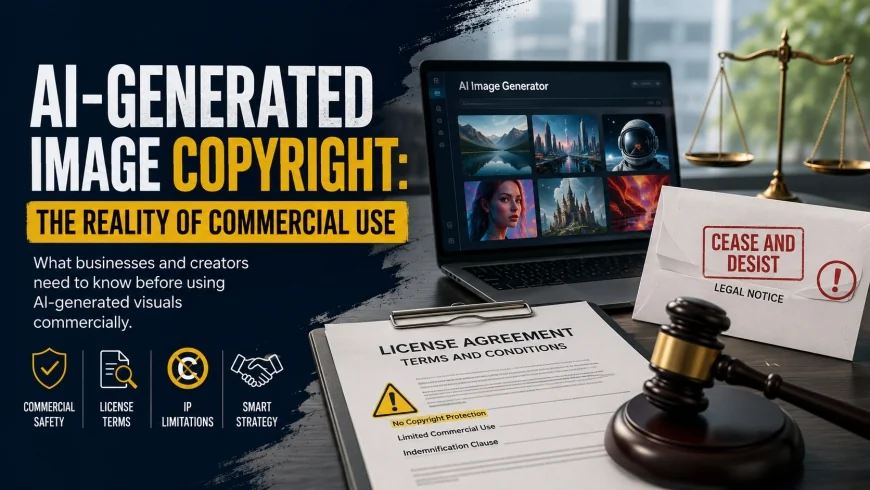
AI-Generated Image Copyright: The Reality of Commercial Use
Imagine launching a major ad campaign only to receive a cease-and-desist letter because your core marketing visuals cannot be legally protected. As generative tools reshape creative workflows, many businesses are finding out the hard way that their digital assets are built on incredibly fragile legal ground.
What this article helps you decide
This guide helps creative directors, agency owners, and independent designers identify which generative platforms offer genuine commercial safety. You will learn how to parse licensing terms, recognize the limits of intellectual property protection, and structure your creative pipelines to minimize legal vulnerability.
Analysis Methodology
This analysis is based on a thorough review of public platform documentation, developer licensing agreements, current copyright office circulars, and real-world creative workflows. We focus on evaluating how these terms translate into day-to-day agency operations, skipping the marketing hype to address actual business utility.
Overview & Market Context: The Illusion of Ownership
The rush to integrate generative tools into content production has created a complex landscape for digital creators. However, navigating AI-generated image copyright guidelines requires looking past the enthusiastic claims of software developers.
A common misconception among creators is that a premium subscription automatically secures exclusive ownership of the output. In practice, our current legal frameworks are still struggling to accommodate non-human creation, leaving many commercial projects exposed.
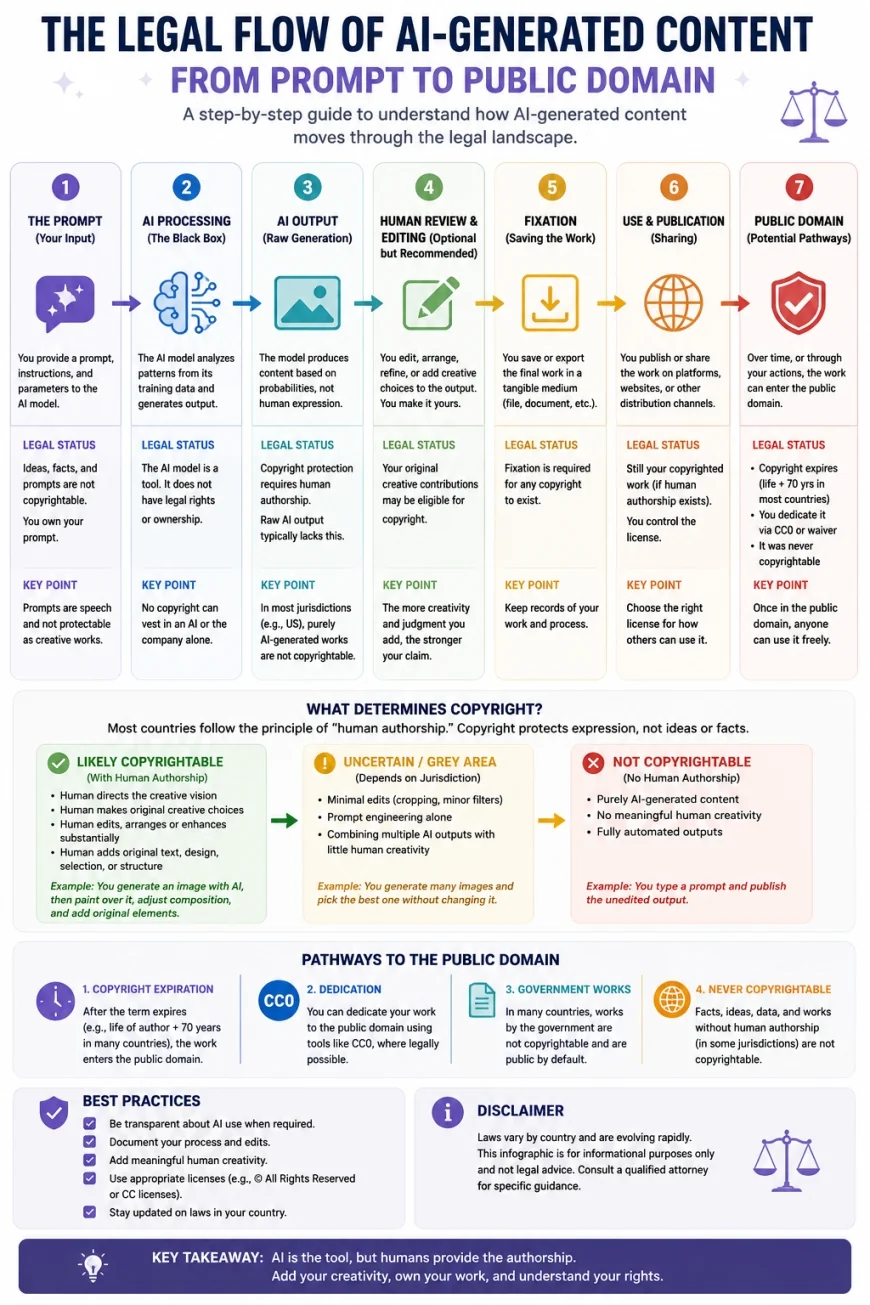 Figure 1: The legal pathway of generative imagery and where ownership rights typically disintegrate.
Instead of dense legal jargon, this guide translates platform policies into clear, actionable rules. This ensures freelancers and studios know exactly what can be safely handed over to a paying client.
Relying on raw, unedited algorithmic outputs for client deliverables can introduce significant commercial liability. Distinguishing between a platform's permission to use an image and statutory intellectual property protection is now a fundamental business skill.
The Legal Pillars: Human Authorship and Algorithmic Randomness
To understand how intellectual property rules for synthetic media operate, we have to look at the foundations of copyright law. The core of global intellectual property protection rests on the human authorship requirement.
Without direct human execution, a creative work generally cannot receive traditional copyright defense. Pure machine outputs are essentially relegated to the public domain from the moment of creation, regardless of how detailed or creative the input prompt was.
The Landmark Rulings Defining the Boundaries
In the United States, this boundary was reinforced by federal courts in decisions like Thaler v. Perlmutter. The court affirmed that copyright protection requires human origin, denying protection to works created autonomously by machines.
The U.S. Copyright Office has consistently maintained that standard text prompts do not constitute sufficient creative control. Simply typing descriptive keywords does not make a user the legal author of the resulting pixel arrangement.
Meanwhile, the European Union's regulatory environment is introducing strict transparency mandates under the EU AI Act. These guidelines require developers to disclose the datasets used to train their systems, adding another layer of compliance for professional users.
💡 Expert Analysis & Experience
The line between minor adjustments and 'substantial' human modification is highly subjective and varies by jurisdiction. In professional production pipelines, basic color grading or contrast adjustments are rarely enough to satisfy copyright offices, whereas multi-layered manual compositing often is.
The Mio/Konektra Framework in EU Courts
An important concept emerging in European legal discussions is the Mio/Konektra framework. Under this approach, courts look for clear evidence that the creator's specific, intentional choices survived the inherent randomness of the generative engine.
If the final visual is primarily the product of algorithmic probability rather than human direction, any claim to exclusive copyright quickly falls apart. This reality is forcing professional studios to document their digital design steps in detail.
Platform-by-Platform Breakdown: Commercial Terms vs. Statutory Reality
To operate safely, it is helpful to look at the terms of the individual tools dominating the creative space. There is often a significant gap between what a platform's terms of service permit you to do and what actual statutory law protects.
Here is how the leading tools handle licensing, indemnity, and ownership rights.
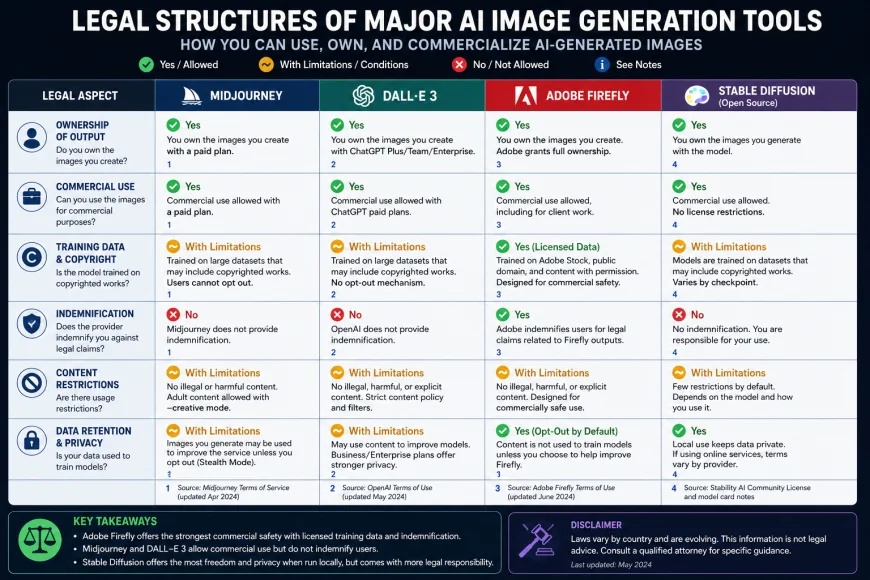 Figure 2: Visual matrix comparing licensing permissions versus actual legal ownership across leading platforms.
Midjourney: High Quality, Zero Exclusive Ownership
Midjourney is a favorite for generating highly stylized, detailed aesthetics with relatively short prompts. However, its legal structure presents clear challenges for agencies building proprietary brand assets.
While a paid subscription grants you permission to use the images for commercial projects, it cannot grant you statutory copyright. Because raw outputs lack human authorship under current laws, the assets you generate remain in the public domain.
This means that while the Midjourney commercial use policy allows you to use your outputs in client work, you cannot stop a competitor from copying, saving, and using those same images. Without copyright protection, legal recourse is incredibly limited.
DALL-E 3: OpenAI’s Terms and IP Indemnification
DALL-E 3, built into ChatGPT and Microsoft's creative ecosystem, is highly effective for rapid concept development. It offers a highly open commercial model, though structural risks remain.
Under the DALL-E 3 intellectual property rights framework, OpenAI waives its own claims to user inputs and outputs. This gives users the freedom to use and monetize the images as they see fit.
However, the platform cannot protect you from external infringement claims if the generator outputs recognizable trademarked properties or copyrighted styles. If these elements end up in a commercial campaign, the risk of generative AI copyright infringement falls on the user.
Adobe Firefly: The Corporate Safety Net Examined
Adobe has built Firefly around corporate safety, training its models on licensed Adobe Stock and public domain content. To reassure corporate clients, they offer intellectual property indemnification under specific enterprise terms.
However, a review of the Adobe Generative AI User Guidelines reveals important limitations. This IP protection is generally restricted to enterprise accounts and applies only when using approved, compliant workflows.
If a prompt intentionally co-ops protected brand names or specific artist styles, those corporate protections are typically voided. Firefly provides a helpful safety net, but only if your prompts and workflows remain strictly managed.
Stable Diffusion: Complete Freedom with Local Liability
Stable Diffusion offers immense flexibility because it can be run locally on your own hardware. This open-source design bypasses centralized platform rules but places the entire legal burden on your operations.
Without central platform guardrails, users can train custom models on proprietary or copyrighted styles. However, doing so increases the risk of producing derivative works that conflict with existing copyrights, leaving the creator entirely responsible for any legal fallout.
✅ Pro Tip
To secure a protectable asset, avoid using raw generative outputs. Instead, adopt a hybrid workflow: use the generator for base textures or layouts, then manually composite, repaint, and adjust the elements in a traditional raster editor to establish clear human authorship.
The Legal Comparison Matrix
This matrix outlines how each major platform handles commercial rights, legal protections, and training data based on their latest public terms of service.
| Platform / Tool | Commercial Use Granted? | Exclusive IP Rights? | Corporate Indemnity Offered? | Training Data Origin |
|---|---|---|---|---|
| Midjourney | Yes (with paid plan) | No (Public Domain) | No | Scraped Web Data |
| DALL-E 3 | Yes | No (Public Domain) | Limited (Enterprise only) | Scraped Web Data |
| Adobe Firefly | Yes | No (Unless heavily modified) | Yes (Enterprise only) | Adobe Stock & Public Domain |
| Stable Diffusion | Yes (Model dependent) | No (Public Domain) | No | LAION Dataset (Scraped) |
Platform Limitations & Who Should Avoid Them
While these tools offer undeniable speed, they come with operational drawbacks that do not fit every business model. For instance, Midjourney relies entirely on Discord for its user interface, which can be chaotic for professional file organization and asset tracking. Stable Diffusion offers ultimate control but features a steep learning curve and requires expensive, high-end GPU hardware to run locally at reasonable speeds.
Furthermore, subscription costs can spike significantly when transitioning from basic personal plans to enterprise tiers that offer actual legal protection. Teams requiring strict, pixel-perfect brand consistency should avoid relying on raw generators, as the unpredictable nature of these engines often leads to frustrating, endless revision loops. If you lack the design resources to manually edit and audit these assets, integrating them directly into client deliverables can create more bottlenecks than it solves.
Advanced Workflows: How Professionals Are Securing Copyrights Legally
To address the limitations of raw AI generations, professional studios are moving away from simple prompting toward complex, multi-stage production pipelines. This is where the practical answer to selling AI art legally becomes clear.
Instead of expecting the software to deliver a finished product, designers use these tools as advanced digital brushes, combining multiple platforms to create works that meet the standard for human authorship.
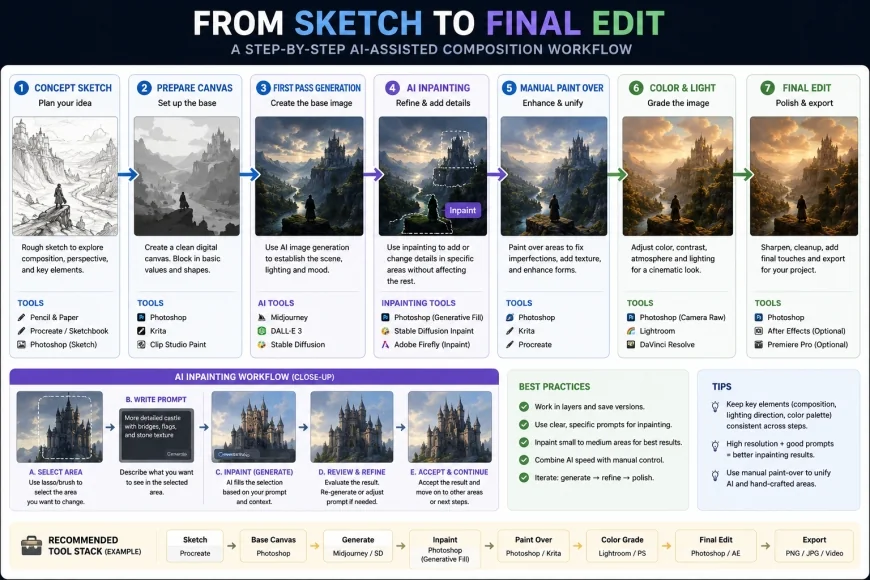 Figure 3: A compliant production pipeline demonstrating the integration of manual painting and generative inpainting.
Inpainting and manual compositing have become standard practices for professional teams looking to protect their work. Recent copyright registration attempts show that administrative offices are much more likely to register works where the final composition relies on clear, human-directed selection and arrangement.
Using an inpainting workflow—where an artist manually paints over specific areas of an image and directs the generator to modify only those localized pixels—creates a documented history of human creative choices that is far easier to defend.
Practical Scenario
A typical professional design pipeline often begins with a hand-drawn layout or a vector mockup. The designer might use Midjourney to generate background elements or specific textures, then manually compile, paint, and refine the composition in Photoshop. This hybrid process ensures the final design is highly original and legally defensible.
Pricing & Licensing Breakdown: The Cost of Legal Safety
Evaluating these systems requires looking beyond subscription costs to the potential liabilities of unprotected assets. Basic platform tiers are affordable, typically ranging from $10 to $30 a month, but these consumer plans offer no legal protections or indemnification if a copyright dispute arises.
For organizations requiring formal legal backing, enterprise agreements are necessary. Adobe’s enterprise packages, for example, involve customized annual contracts that carry higher price tags but provide the risk management features required by corporate legal departments.
Balanced Pros & Cons of Commercial AI Art
Balanced Pros & Cons
- Rapid Prototyping: Quickly build out design directions and mood boards for client presentations.
- Asset Variety: Generate custom base textures and background patterns on demand.
- Targeted Editing: Leverage inpainting to make quick adjustments to specific areas of an image.
- Workflow Versatility: Streamline the initial brainstorming phases of large-scale projects.
- Zero Default Copyright: Raw outputs cannot be registered, meaning competitors can copy them freely.
- Accidental Infringement: Generators may output trademarked properties or styles if not carefully monitored.
- Evolving Regulations: Global legal standards are changing quickly, creating compliance risks.
- Conditional Indemnity: Platform protections often feature strict exclusions and prompt limitations.
Target Audience: Who Should Use What?
Your strategy for managing creative asset ownership should align with your specific role, client expectations, and appetite for risk.
Freelance Illustrators & Designers: If you deliver final creative assets to clients, avoid raw generative outputs. Use these tools for reference, mood boarding, or base layers, ensuring the final deliverable features substantial manual work.
Marketing and Advertising Agencies: For high-volume commercial campaigns, prioritizing platforms like Adobe Firefly Enterprise makes sense. The financial protection of their IP indemnity, paired with clear prompting policies, helps shield your agency and clients from litigation.
Indie Game Developers & Concept Artists: Running Stable Diffusion locally on your own hardware, combined with custom training on proprietary art assets, is often the most effective route. This setup keeps your training data clean and reduces the risk of third-party copyright claims.
Recommended Choices by Purpose
For corporate workflows requiring indemnity and compliance, Adobe Firefly Enterprise remains the clear choice. For rapid creative exploration and internal brainstorming where copyright is not a priority, Midjourney continues to offer the most polished aesthetic results. For studios looking to build custom, local pipelines using their own proprietary training assets, Stable Diffusion provides the necessary flexibility.
Frequently Asked Questions
Can I legally sell raw, unedited AI-generated images?
Yes, you can sell them, but you cannot claim exclusive ownership over them. Because raw outputs cannot be copyrighted, they enter the public domain, meaning anyone else can legally save and resell the exact same visuals.
Does a paid platform subscription protect me from copyright lawsuits?
No. A subscription simply allows you to use the platform's processing power and commercially use the output under their service agreement. It does not protect you if the generated image looks too similar to someone else's copyrighted work.
What is the "American Cheese" copyright registration?
This refers to a notable registration case where an artist successfully secured a copyright by demonstrating that their use of generative tools involved highly complex, multi-layered compositing and manual edits, establishing clear human authorship.
How much editing is needed to copyright an AI-assisted image?
There is no set percentage. Registrars look for meaningful human creative control, meaning your manual adjustments, color grading, and compositing choices must outweigh the random output of the generator.
Are these generators trained on copyrighted material?
This is a major point of ongoing legal debate. Many models were trained on web-scraped images without direct creator consent, which remains the focus of several active class-action lawsuits.
Your Step-by-Step Legal Safety Checklist
To protect your creative business when working with modern digital tools, consider adopting these standard safety practices:
- Review the platform's specific Terms of Service to verify commercial use rights.
- Use hybrid workflows (manual compositing, digital painting, inpainting) to ensure human creative control.
- Document your design history by saving draft files, sketches, and layer files to prove your creative process.
- Avoid protected brand names, trademarks, or specific living artists in your text prompts.
- Consult intellectual property counsel when planning high-exposure commercial campaigns.