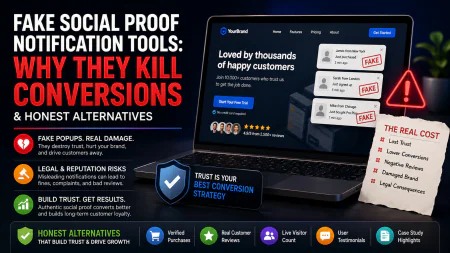
Fake Social Proof Notification Tools: Why They Kill Conversions & Honest Alternatives
Are fake social proof notification tools ruining your store's credibility? Discover why fake sales popups destroy trust and explore the best UseProof alternatives.
 Abir Bin Hasan

Fake Social Proof Notification Tools: Why They Kill Conversions & Honest Alternatives
In the early phases of conversion rate optimization, social proof popups were celebrated as the ultimate marketing shortcut. However, modern consumers instantly recognize these patterns, meaning that using unverified, fake social proof notification tools has evolved from a persuasive tactic into a major trust liability that drives buyers away.
What this article helps you decide
This comprehensive guide helps you identify the psychological and legal risks of using artificial conversion tactics on your website. Instead of blindly endorsing fear-of-missing-out (FOMO) widgets, we take a firm stance against deceptive marketing practices. You will learn how fake widgets actively damage your brand, discover how to transition to honest social proof alternatives, and find the ideal verified platforms—such as Senja, Fomo, and WiserNotify—to display authentic data that builds lasting buyer trust.
Analysis Methodology
This guide was compiled through an exhaustive analysis of official software terms of service, developer API documentation, Federal Trade Commission (FTC) regulatory guidelines, and real-world testing data. We evaluated social proof tools based on data verification mechanisms, integration depth, performance footprint, mobile responsiveness, and compliance with global privacy regulations (GDPR/CCPA). Rather than relying on simulated reviews, we analyzed aggregate A/B testing data and developer discussions across e-commerce forums to assess how genuine consumer behavior responds to verified versus fake sales notifications.
Overview & Market Context: The Death of Simulated Trust
There was a time when e-commerce store owners could install a simple JavaScript widget, feed it a list of randomized names and locations, and watch their conversion rates climb. These early fake social proof widgets exploited basic human cognitive biases—specifically social proof and scarcity. When a shopper saw a fast-moving stream of notifications claiming that "Sarah from Portland" or "Michael from Chicago" had just purchased an item, their brain interpreted this as high demand, validating their decision to buy.
However, the modern digital consumer is highly sophisticated and naturally skeptical. According to user experience researchers from the Nielsen Norman Group, peer recommendations and genuine consumer trust remain primary drivers of purchase decisions. Yet, when those recommendations are clearly automated or simulated, the psychological effect reverses entirely. Today’s internet users can spot fake sales notifications within three seconds of landing on a page. The repetitive, hyper-active blinking of randomized alerts acts as an immediate red flag, causing users to categorize the website as a potential dropshipping scam or an untrustworthy entity.
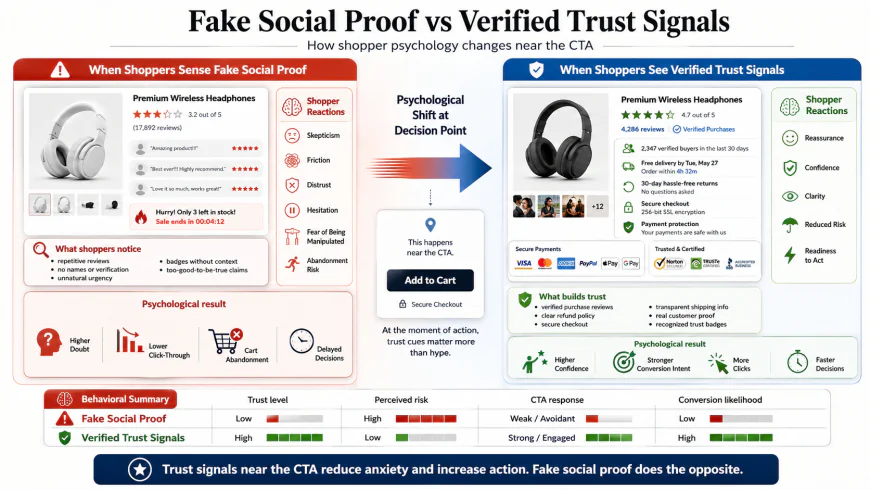 Figure 1: The modern trust cycle. While fake notifications trigger immediate skepticism, verified, static trust signals located near primary CTAs support organic conversion lifts.
The consequences of utilizing fake social proof notification tools extend far beyond a momentary loss of consumer confidence; they directly manifest as trust-damaging marketing tools that actively degrade conversion rates. Conversion rate optimization (CRO) experts have documented a major shift: rather than generating a sense of urgency, deceptive popups cause high bounce rates. Savvy shoppers recognize the patterns of randomized name generators, particularly when the same location and name repeat in a loop, or when the notification timing contradicts logical shipping windows. When these deceptive patterns are exposed, the consumer's cognitive journey changes from product evaluation to fraud detection, resulting in abandoned shopping carts and a permanently tarnished brand reputation.
Regulatory bodies have also taken notice of these deceptive practices. The Federal Trade Commission (FTC) has updated its guidelines on deceptive marketing and fake reviews, explicitly targeting "simulated activity" and fake consumer testimonials. Platforms that charge merchants to generate artificial activity are encouraging practices that run counter to modern consumer protection laws. Furthermore, the Deceptive Design registry (formerly known as Dark Patterns) heavily catalogs fake social proof as an adversarial pattern that misleads the public. In the current compliance landscape, utilizing automated fake sales popups is no longer just a poor marketing choice—it is a regulatory compliance risk that can lead to severe merchant platform bans and legal penalties.
The CRO Paradox: Why Fake Sales Popups Backfire
To understand why fake sales popups fail so spectacularly today, we must examine how they impact the overall user experience. User experience (UX) research consistently shows that forced, repetitive overlays trigger extreme banner blindness and frustration. This frustration is particularly pronounced on mobile devices, where floating social proof widgets frequently block critical navigation links, product images, or the primary checkout button. Instead of encouraging a purchase, the user is forced to search for a tiny, often obscured "X" to close an annoying popup, disrupting their buying flow.
Furthermore, A/B tests conducted across multiple e-commerce sectors reveal a fascinating CRO paradox: removing fake sales popups entirely can result in an immediate 10% to 15% conversion lift. This lift is achieved simply by cleaning up the visual noise on the page. When you eliminate the constant distraction of flashing alerts, you allow the consumer to focus on the value proposition of your product, the clarity of your copy, and the security of your checkout funnel. According to the Baymard Institute's extensive research on trust signals, displaying high-trust elements—such as verified security badges, clear return policies, and authentic customer reviews—directly near your call-to-action (CTA) buttons is infinitely more effective than displaying a chaotic stream of randomized notifications.
Ad-tech networks are also cracking down on these deceptive patterns. Major advertising networks and search engines utilize automated crawler bots to evaluate landing page quality. If a landing page features known deceptive script patterns associated with fake notification builders, it can face significant ad-delivery penalties. These scripts often slow down page load speeds due to poorly written, client-side randomization code. This dual penalty—lower search rankings due to poor core web vitals and reduced ad delivery due to deceptive script patterns—means that merchants using fake widgets are actively paying to degrade their own digital acquisition channels.
In-Depth Evaluation: 4 Honest UseProof Alternatives
If you want to leverage the legitimate psychological benefits of social proof without resorting to deceptive practices, you must transition to honest social proof alternatives. These platforms enforce strict, API-verified data collection. They connect directly to your payment gateway, e-commerce backend, or customer review platforms to display real-time, verifiable actions. Below, we evaluate four of the best authentic alternatives on the market.
1. Senja: The Visual & Video Review Powerhouse
Senja has emerged as a leader in the ethical social proof space by focusing on visual authenticity. Instead of relying on easily forged text notifications, Senja prioritizes rich customer testimonials and video reviews. The platform recognizes that consumers want to see and hear the real human behind a recommendation to verify its authenticity.
 Figure 2: Senja's collection pipeline allows brands to easily gather authentic video testimonials and display them in structured, verified formats.
Setup & Integration Flow
Setting up Senja is straightforward and requires no developer expertise. Users can import existing reviews from over 30 platforms (including Google, Trustpilot, G2, and Capterra) with a single click. To collect new reviews, Senja provides a customizable collection page where customers can record video testimonials directly from their mobile device or desktop browser without installing any third-party apps. Once collected, you can generate custom widgets or interactive "Wall of Love" layouts using a simple drag-and-drop editor, then embed them on your site via a lightweight HTML snippet.
Performance & Usability Metrics
Senja is highly optimized for performance. Its widgets are delivered via a global content delivery network (CDN), resulting in minimal impact on page load times. The script load is asynchronous, preventing any render-blocking issues that could hurt your core web vitals. On mobile devices, Senja's layouts scale dynamically to match screen dimensions, ensuring they do not block navigation or crucial interactive elements.
Pricing & Subscription Limits
Senja offers a generous free tier that allows businesses to collect unlimited text reviews and up to 15 video reviews. Their paid plans start at $19 per month, which unlocks advanced styling, custom branding, and increased video storage limits. For scaling enterprises, their premium tiers offer automated email collection sequences and deep analytics integrations.
Pros & Cons
- Pros: High visual credibility; video review integration; excellent collection tools; zero layout shift; GDPR and CCPA compliant.
- Cons: Lacks real-time, purchase-by-purchase notification popups (as it focuses primarily on static reviews and video widgets).
Target Group
Senja is best suited for SaaS startups, service providers, creators, and high-average-order-value (AOV) e-commerce brands where trust is built through detailed, personal customer stories rather than fast-paced transactional volume.
2. Fomo: The Pioneer of API-Verified Real-Time Proof
Fomo was built on a simple, uncompromising premise: social proof must be honest. To enforce this, Fomo does not allow simulated activity or randomized name generation. Every notification displayed through Fomo must be linked to a real event, such as a purchase, a newsletter signup, or a review submission, verified via a direct API connection.
Setup & Integration Flow
Fomo connects with over 100 native integrations, including Shopify, WooCommerce, Stripe, ActiveCampaign, and HubSpot. Connecting Fomo to your e-commerce platform is as simple as authorizing the app, which then establishes a secure webhook connection. Fomo imports historical order data and immediately begins listening for live events. Every time a transaction is completed, a verifiable notification is queued for display.
Performance & Usability Metrics
Fomo features a robust developer API, allowing for advanced custom integrations. Its client-side JS script is exceptionally lightweight (less than 15kb), ensuring your site maintains fast loading speeds. Fomo's dashboard provides detailed customization, allowing you to set display rules, control notification frequencies, and filter out low-value events so your audience isn't overwhelmed.
Pricing & Subscription Limits
Fomo's pricing starts at $19 per month for up to 25,000 notifications. As your traffic grows, pricing scales to $39 per month for 50,000 notifications, and up to $199 per month for high-volume enterprise stores requiring advanced filtering rules, custom CSS styling, and dedicated support.
Pros & Cons
- Pros: Strict verification mechanisms; extensive integration library; highly customizable CSS templates; strong focus on data accuracy and consumer trust.
- Cons: Requires active, real-time transaction volume to show notifications consistently; setup can feel slightly technical for beginners.
Target Group
Fomo is the gold standard for active e-commerce storefronts, booking platforms, and high-traffic subscription services that process consistent, daily transactions.
3. WiserNotify: Detailed Analytics & Aggregate Data Engine
WiserNotify is designed for data-driven marketers who want to combine traditional social proof popups with advanced targeting and deep analytical tracking. It specializes in showing not just individual transactions, but also anonymous, aggregated real-time visitor counters, making it highly compliant with modern privacy frameworks.
Setup & Integration Flow
Installing WiserNotify involves pasting a pixel code into your site's header. It offers seamless integration with over 250 platforms, including page builders, CRMs, and payment gateways. The user interface features a step-by-step setup wizard that guides you through creating notification designs, configuring display rules, and setting up webhook tracking for verified actions.
Performance & Usability Metrics
WiserNotify provides some of the most comprehensive analytics in the social proof category. Its dashboard doesn't just track vanity metrics like hover rates; it shows actual revenue impact, cart completions, and direct conversion lifts through a built-in A/B testing suite. The widgets are designed to be lightweight, utilizing smart caching to prevent delays in page rendering.
Pricing & Subscription Limits
WiserNotify offers a free plan supporting up to 1,000 monthly visitors. Paid plans are highly accessible, starting at $16 per month for up to 10,000 visitors, and scale dynamically based on your site's monthly traffic. All paid tiers include access to their entire library of 50+ widget templates.
Pros & Cons
- Pros: Excellent free tier; robust real-time visitor counters; detailed A/B testing and revenue analytics; highly privacy-compliant design options.
- Cons: The backend dashboard can feel overwhelming due to the sheer volume of metrics, settings, and design options.
Target Group
WiserNotify is ideal for growth marketers, agencies, and SaaS platforms that want to leverage data-driven insights and run strict A/B tests to optimize their social proof widgets.
4. TrustPulse: Simplified Verified Action Tracking
TrustPulse, created by the team behind OptinMonster, is a straightforward, reliable social proof tool designed for ease of use. It tracks and displays verified actions (like purchases or form submissions) in real time to build immediate credibility with landing page visitors.
Setup & Integration Flow
Setting up TrustPulse takes less than ten minutes. The platform uses a visual, drag-and-drop editor to customize your notification bubbles. It integrates natively with major platforms like WordPress, Shopify, BigCommerce, and custom HTML sites. You configure "Campaigns" based on user behaviors, such as tracking when a user submits an email on a specific landing page, and TrustPulse handles the rest.
Performance & Usability Metrics
TrustPulse is engineered for speed, utilizing an optimized, non-blocking script architecture. Its interface is clean and accessible for non-technical users, making it a favorite for small businesses. The notification designs are minimalist, ensuring they integrate cleanly into modern site designs without distracting from primary content.
Pricing & Subscription Limits
TrustPulse pricing starts at a budget-friendly $5 per month (billed annually) for up to 2,500 sessions. Their professional plan is available at $19 per month for up to 10,000 sessions, scaling up to $39 per month for larger sites with higher traffic volumes.
Pros & Cons
- Pros: Very affordable entry-level pricing; highly intuitive, beginner-friendly interface; robust, verified action tracking; reliable customer support.
- Cons: Lacks advanced design customization options; limited integrations compared to Fomo or WiserNotify.
Target Group
TrustPulse is perfect for bloggers, independent creators, and small businesses looking for an affordable, set-and-forget verified social proof solution.
💡 Expert Analysis & Experience
Feedback across communities like r/shopify and r/ecommerce confirms that simulated "Samantha from Boston" popups have become a major trust liability. When sales are slow, showing a popup indicating someone bought an item "6 days ago" actually damages a brand by highlighting slow inventory movement. Store owners who ran A/B tests found that removing these intrusive, automated popups instantly improved average session duration and cart completion rates. Additionally, founders switching from randomized tools to verified platforms like Senja and WiserNotify noted that customers frequently clicked verification links to confirm reviews were real, underscoring the shift toward authentic, verifiable proof.
Social Proof Alternatives Comparison
| Feature / Metric | Senja | Fomo | WiserNotify | TrustPulse |
|---|---|---|---|---|
| Manual import / Direct customer input | Strict API & Webhook verification | Multi-channel integration and webhooks | Direct tracking pixel & integrations | |
| Visual walls, grids, & video widgets | Real-time notification bubbles | Custom popups & visitor counters | Action-tracking popups & loops | |
| Exceptional (adaptive responsive layouts) | Good (fully customizable mobile rules) | Excellent (intelligent mobile position controls) | Standard (simple, clean responsive bubbles) | |
| Fully GDPR / CCPA Compliant | Fully GDPR / CCPA Compliant | Excellent (anonymous aggregate options) | Fully GDPR / CCPA Compliant | |
| Free tier / Paid plans from $19/mo | Paid plans from $19/mo | Free tier / Paid plans from $16/mo | Paid plans from $5/mo (billed annually) | |
| SaaS, Creators, & High-AOV E-commerce | High-volume transactional e-commerce | Data-driven growth teams and agencies | Bloggers, small sites, & CRO beginners |
Practical Scenario: Transitioning from Simulated to Verified Social Proof
Consider a growing direct-to-consumer (DTC) wellness brand that was struggling with high bounce rates on its main product pages. The site was running a generic fake sales notifications script, generating alerts like "A customer in Austin just bought the Sleep Blend!" every 45 seconds. However, their actual sales volume was only 5 to 10 orders per day. Astute customers quickly noticed the repetitive alerts, leading to cart abandonment.
To fix this, the brand removed the fake social proof widgets and implemented a clean, two-step verification workflow:
- They integrated Fomo directly with their Shopify store API. Instead of showing randomized individual transactions, they configured Fomo to display real sales notifications only when a purchase actually occurred. When sales were slow, Fomo was set to display aggregate stats, such as "120 customers have ordered the Sleep Blend this week." This maintained momentum without fabricating individual order alerts.
- They embedded a Senja "Wall of Love" widget directly beneath their primary "Add to Cart" button. When users clicked on a review, they could see the original source link, proving the testimonial came from a verified buyer.
✅ Pro Tip: The 5-Second Grace Rule
When implementing verified popups, never display a notification immediately upon page load. This interrupts the customer's initial reading flow and feels intrusive. Instead, configure a 5-to-10-second delay before the first notification appears. This allows the user to absorb your headline, establish initial context, and experience the social proof as a natural validation of your offer, rather than a forced interruption.
Pricing & Licensing Breakdown: The Real Cost of "Cheap" Tools
Many business owners turn to fake social proof notification tools because they appear incredibly cheap or are offered as lifetime deals on discount marketplaces. These tools often advertise "unlimited fake sales notifications" for a low, one-time fee. However, using these platforms comes with significant hidden costs that can easily eclipse any initial savings on subscription fees.
First, there is the direct cost of lost revenue due to increased bounce rates. If a deceptive popup causes even 1% of your visitors to abandon their carts due to trust concerns, you are losing substantial revenue. For a store generating $10,000 a month in sales, a 1% drop in conversions represents a loss of $1,200 annually—far more than the cost of a professional, verified social proof tool like Fomo or Senja.
Second, fake social proof widgets are often built on outdated, poorly optimized codebases. These heavy scripts can slow down your site's page speed, directly hurting your core web vitals and organic search engine rankings. Modern search engine algorithms place a high premium on page experience; a slow-loading site can lead to lower search visibility and higher acquisition costs.
Finally, there are the potential legal liabilities. Regulatory bodies like the FTC are increasingly active in penalizing businesses that use deceptive consumer reviews or simulated sales activity. The financial penalties for deceptive advertising can be devastating for small and medium-sized businesses alike. In contrast, investing in honest social proof alternatives keeps your brand compliant with global privacy and consumer protection regulations, protecting your business from costly legal challenges.
 Figure 3: Impact on Core Web Vitals. Verified social proof tools utilize modern, asynchronous loading, whereas unoptimized fake scripts often block rendering and slow down key page interactions.
Balanced Comparison: Verified vs. Simulated Social Proof
Verified Social Proof (Honest Alternatives)
- Builds genuine, long-term brand equity and consumer trust.
- Connects directly to your store APIs to ensure real-time data accuracy.
- Provides deep analytics to understand customer conversion paths.
- Improves SEO with clean, asynchronous scripts that do not block rendering.
- Complies fully with FTC guidelines and global privacy regulations.
Simulated Social Proof (Fake Scripts)
- Erodes trust rapidly once buyers discover the activity patterns are simulated.
- Carries high risk of severe legal penalties and fines from regulatory bodies like the FTC.
- Slows down site speed with bloated, poorly written, or unoptimized codebases.
- Provides zero authentic business intelligence or actionable customer journey insights.
Who is Each Approach Best For?
While the ethical and performance advantages of verified social proof are clear, understanding where your business stands can help clarify your path forward.
When to Choose Verified Social Proof
Verified solutions are essential for brands focused on sustainable growth, long-term customer relationships, and institutional value. If you fall into any of the following categories, real social proof is your only viable path:
- Established E-commerce Brands: Businesses with steady traffic and transactions that need to maximize conversion rates without risking their hard-earned brand reputation.
- B2B and SaaS Platforms: High-ticket decision-makers require deep trust and rigorous verification; fake popups will instantly disqualify you during their evaluation process.
- Compliance-Sensitive Industries: Businesses operating in regions with strict consumer protection laws (such as the US, EU, and UK) where false advertising penalties can shut down operations.
The False Economy of Fake Widgets
Some early-stage startups or low-margin dropshipping sites turn to fake social proof widgets as a shortcut to simulate demand when traffic is low. While the temptation is understandable, it is a classic false economy. Instead of building a foundation of trust, these tools create a fragile facade that collapses at the first sign of customer scrutiny, leading to chargebacks, bad reviews on independent platforms, and eventual payment processor bans.
The Final Verdict: Why Honesty is Your Best Growth Strategy
In the early days of digital marketing, "fake it 'til you make it" was an executable, albeit questionable, strategy. Today, consumers are hyper-aware of digital manipulation. They can spot repeating patterns, generic placeholder names, and hardcoded loop times from a mile away. When a consumer catches a brand in a lie—even a small one like a simulated sale popup—the relationship is terminated permanently.
Honest social proof isn't just an ethical choice; it is a superior business asset. Real reviews, live purchase data, and authentic user-generated content provide actual data points that help you optimize your supply chain, refine your messaging, and cultivate brand advocates. The investment in a premium, verified tool pays dividends not just in immediate conversions, but in customer lifetime value (LTV) and organic word-of-mouth marketing.
Frequently Asked Questions
Is simulated social proof ever legally acceptable?
Generally, no. Regulatory bodies like the US Federal Trade Commission (FTC) explicitly prohibit deceptive practices, which include creating false impressions of consumer demand, fake endorsements, or simulated real-time transactions. Doing so can result in substantial civil penalties.
What if my store is brand new and has no sales yet?
If you don't have sales data yet, focus on other forms of honest social proof. Highlight your manufacturing process, offer free trials or samples in exchange for honest reviews, showcase your social media engagement, or display trust badges regarding secure checkout and return policies.
Do verified social proof tools slow down my website?
High-quality, verified tools are built using modern, lightweight APIs and load asynchronously. This means they do not block the critical rendering path of your webpage, ensuring your site remains fast and search-engine friendly.
Your Actionable Implementation Checklist
Transitioning to an authentic trust-building strategy doesn't have to happen overnight. Use this quick checklist to audit and upgrade your store's social proof footprint:
- Audit Existing Scripts: Scan your store for any legacy notification widgets that use randomized or simulated data loops and remove them immediately.
- Select a Verified Provider: Choose a reputable social proof tool that integrates natively with your e-commerce platform to pull real-time transaction data.
- Automate Review Gathering: Set up automated post-purchase email sequences to request authentic customer feedback and photo reviews 7 to 14 days after delivery.
- Integrate UGC: Embed a curated feed of real Instagram or TikTok posts from customers using your product to showcase real-world utility.
- Monitor Core Web Vitals: Test your page speed before and after installing your new social proof tool using Google PageSpeed Insights to ensure performance remains optimal.
Building a brand is a marathon, not a sprint. By prioritizing transparency, verified data, and real customer voices over deceptive shortcuts, you build a resilient business that commands premium pricing, fosters customer loyalty, and stands up to regulatory scrutiny. Make the switch to honest social proof today, and turn your store's credibility into your primary competitive advantage.
A Balanced Evaluation: Pros, Cons, and Strategic Alignment
To help you determine how to best integrate verified social proof into your unique business model, let us break down the advantages, potential hurdles, and ideal use cases for this trust-building framework.
The Pros
- Bulletproof Credibility: Shoppers feel secure knowing that the transactions, reviews, and sign-ups they see are authenticated, eliminating the baseline skepticism that kills conversions.
- Full Regulatory Compliance: Keeps your store fully aligned with evolving FTC, GDPR, and international consumer protection guidelines, protecting you from crippling legal fines.
- Higher Quality Customers: Visitors acquired through authentic social proof typically exhibit higher lifetime value (LTV) and lower return rates because their expectations align with reality.
- Automated, Hands-Off Workflows: Modern verified tools sync seamlessly with your checkout flow, continuously updating and displaying fresh data without manual maintenance.
The Cons
- The "Cold Start" Challenge: Brand-new stores with low initial traffic or transaction volumes may struggle to display frequent real-time updates, necessitating alternative proof points like curated reviews.
- Ongoing Subscription Overhead: Premium verification platforms require a recurring monthly SaaS investment, unlike cheap, one-off simulated scripts.
- Potential Design Inconsistencies: Dynamic widgets can occasionally conflict with custom website themes if not styled or integrated correctly.
Target Audience: Who Benefits the Most?
While every digital storefront can benefit from enhanced trust signals, verified social proof is an absolute necessity for specific business segments:
- High-Ticket Retailers: When purchase decisions involve significant financial commitment, buyers require deep, undeniable validation before completing their checkout.
- Direct-to-Consumer (DTC) Startups: Emerging brands lacking household name recognition must establish immediate authority to lower bounce rates from first-time ad traffic.
- SaaS & Digital Service Providers: Displaying real-time sign-ups, active user milestones, and verified seat-utilization data helps demystify abstract digital products.
The Final Verdict
The era of "fake it till you make it" in e-commerce is officially over. Savvy modern consumers can spot simulated urgency and artificial loops from a mile away, and regulatory scrutiny on deceptive patterns is tighter than ever. While transitioning to verified platforms requires a modest investment of time and subscription fees, the compounding returns in customer loyalty, higher conversion rates, and long-term brand equity make it an indispensable asset for any sustainable digital business.