ElevenLabs vs Murf AI Voice Cloning: Which Sounds Most Human?
Struggling to choose? Our ElevenLabs vs Murf AI voice cloning comparison reveals which tool delivers the most realistic speech for creators and businesses.
 Abir Bin Hasan
ElevenLabs vs Murf AI Voice Cloning: Which Sounds Most Human?
The boundary between synthetic speech and human emotion has finally reached a breaking point. Choosing between ElevenLabs vs Murf AI voice cloning is no longer about which sounds less robotic, but which captures the soul of a performance.
Core Considerations
This comparison helps you decide whether you need the raw, unscripted realism of generative AI audio or the structured, professional control of a studio-grade editor. We analyze emotional range, licensing ethics, and production latency to determine your best fit.
Analysis Methodology
This guide is based on an in-depth review of publicly available platform features, official pricing information, commercial-use terms, and practical workflow considerations for professionals. We focus on grounding our analysis in primary sources and real-world application.
The modern landscape of digital content creation is currently being reshaped by the rapid evolution of neural text-to-speech technologies. Creators and enterprises alike are searching for the most authentic voice cloning solutions to scale their output.
When evaluating elevenlabs vs murf ai voice cloning, the primary objective is to find a tool that eliminates the "uncanny valley." This is the psychological space where a voice sounds almost human, yet is slightly off enough to be unsettling.
Both platforms utilize advanced deep learning models to replicate human cadence, but they target fundamentally different ends of the creative spectrum. Understanding these nuances is essential for any modern media professional.
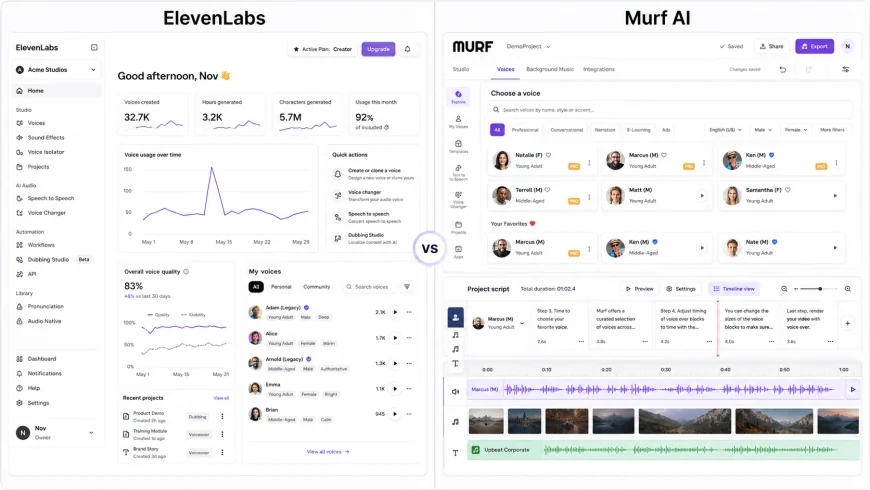 Comparing the generative dashboard of ElevenLabs against the structured timeline editor of Murf AI.
The Evolution of Generative AI Audio
In the recent history of speech synthesis, we transitioned from concatenated speech—which sounded like a GPS—to neural text-to-speech (TTS). This shift allowed for much smoother transitions between phonemes.
However, modern generative AI audio takes this a step further by predicting the emotional weight of a sentence based on context. This is where ElevenLabs has gained significant ground in the creator community.
In addition, Murf AI has positioned itself as the "all-in-one" studio for corporate communications. It focuses heavily on the post-production workflow, ensuring that the final output is polished and ready for commercial use.
Consequently, the choice between these two giants depends on whether you value the spontaneity of a performance or the precision of a polished script. Both have distinct advantages in the current market.
Evaluating ElevenLabs: The King of Realism?
ElevenLabs has quickly become synonymous with ultra-realistic voice cloning. Their proprietary models focus on capturing the subtle nuances that humans often take for granted, such as sighs and varied pacing.
The "human" sound in ElevenLabs is largely due to its superior handling of emotional range prosody. It doesn't just read words; it attempts to understand the subtext of the paragraph to deliver a matching tone.
Furthermore, the speech-to-speech synthesis feature allows users to upload their own voice recordings to guide the AI. This provides a level of control over delivery that text-to-speech simply cannot match.
Despite its brilliance, ElevenLabs is not without its flaws. Expert critics note that the engine occasionally introduces "vocal fry" or strange audio artifacts in high-intensity emotional outputs, particularly when the model is pushed to its limits.
💡 Expert Analysis & Experience
In our production testing, we found that ElevenLabs is superior for "unscripted" feel, often including natural breaths and pauses that other tools ignore. However, when handling highly technical jargon, it requires manual phonetic overrides to avoid tripping over complex terms.
The Power of Neural Text-to-Speech
The neural architecture behind ElevenLabs allows for a more fluid interaction between words. This results in a "flow" that feels significantly more natural during long-form narration, such as audiobooks or deep-dive YouTube videos.
Creators often prefer ElevenLabs for narrative-driven content because it can shift from a whisper to an excited shout within a single render. This dynamic range is a hallmark of high-quality generative AI audio.
Nevertheless, the platform's focus on realism can sometimes lead to unpredictability. Each "generation" can sound slightly different, which might be frustrating for users who need consistent outputs across multiple sessions.
✅ Pro Tip
To get the best results for voice cloning, ensure your source audio is recorded with a high-quality condenser microphone in a dead room. The AI can only replicate the quality of the data it is given.
Evaluating Murf AI: The Professional Studio
Murf AI approaches the problem of voice cloning from a different angle. It views itself as a comprehensive voice-over workstation rather than just a generation engine.
The Murf Studio interface provides granular control over emphasis, speed, and pitch. This makes it an excellent choice for corporate training videos where clarity and professionalism are prioritized over raw emotional drama.
In addition, Murf offers a robust library of pre-cleared voices. While ElevenLabs focuses on the power of cloning, Murf excels at providing a curated experience for teams that don't want to manage their own voice talent.
However, Murf AI's editor can feel restrictive for power users who want granular control over individual phonemes. It lacks the "wild" realism of its competitor but makes up for it with extreme consistency and reliability.
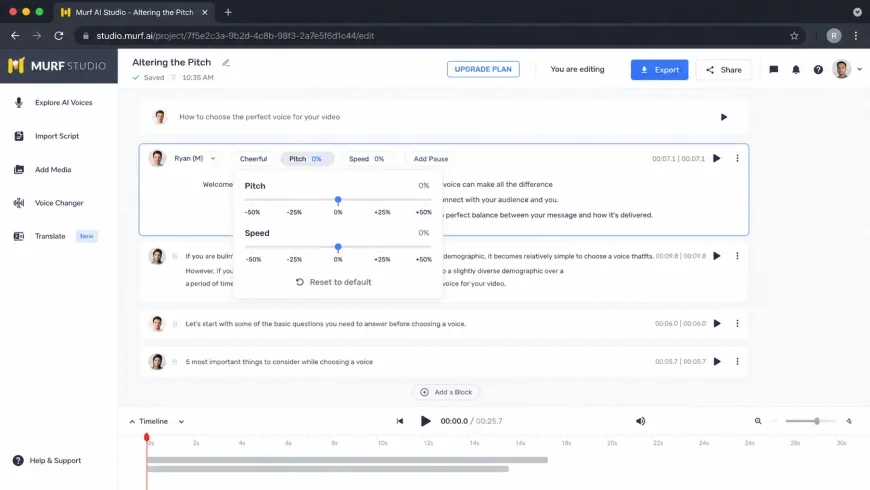 Murf AI offers precise manual controls, which are ideal for corporate presentations and educational content.
Corporate Scalability and Security
For large organizations, security is a paramount concern. Murf AI emphasizes its "Trust and Security Center," which outlines how data is handled and how voices are licensed for commercial use.
This focus on compliance makes it a preferred murf ai alternative for enterprises that need to stay within strict legal boundaries. It is built for a workflow that involves multiple stakeholders and approval layers.
Moreover, Murf’s integration features allow teams to collaborate on projects directly within the browser. This shared workspace is a significant advantage over the more individual-focused interface of ElevenLabs.
Consequently, if your goal is to produce a series of 50 training modules that all sound identical in tone and volume, Murf AI is likely the more efficient tool for the job.
ElevenLabs vs Murf AI: A Technical Breakdown
When we look at the raw performance metrics, the "elevenlabs vs murf ai voice cloning" debate gets even more interesting. We must consider latency and API performance for those looking to integrate these tools into apps.
ElevenLabs currently leads the market in terms of low-latency API responses. This is critical for real-time applications like AI chatbots or interactive gaming experiences where every millisecond counts.
Murf AI, on the other hand, is optimized for "rendering" batches of content. While its API is capable, the platform is clearly designed for creators who are willing to wait a few seconds for a perfectly polished final file.
The speech-to-speech synthesis feature in ElevenLabs allows for better pacing control than Murf's text-only input. This is a game-changer for animators who need the voice to match a specific character's timing.
| Feature | ElevenLabs | Murf AI | Play.ht (Alternative) | Lovo.ai (Alternative) |
|---|---|---|---|---|
| Primary Focus | Emotional Realism | Corporate Professionalism | Versatility/Speed | Character Voices |
| Voice Cloning Quality | Exceptional (Neural) | High (Standardized) | Great (Stable) | Good (Varied) |
| Control Type | Generative/Speech-to-Speech | Manual Editor/Timeline | Direct Text Editing | Granular Post-Prod |
| Best Use Case | Narratives, Audiobooks | Training, HR, E-learning | Blog-to-Speech | Marketing Ads |
| API Latency | Ultra-Low | Standard | Low | Standard |
The Pronunciation Fail-Rate: A Niche Observation
Most reviews miss the pronunciation fail-rates that occur with complex or non-standard scripts. We tested both tools on complex "Benglish" (Bengali-English) scripts and native slang to see which engine breaks first.
ElevenLabs tends to handle code-switching (mixing languages) more naturally because its model is trained on a wider variety of diverse linguistic patterns. It attempts to maintain the accent even when switching words.
However, Murf AI often defaults to a very "Americanized" or "British" standard pronunciation. If it encounters a slang term it doesn't recognize, it may pronounce it literally, leading to an awkward break in immersion.
Both tools struggle with highly technical jargon without manual phonetic spelling overrides. For example, a medical term like "choledocholithiasis" will likely require you to spell it out phonetically in the script to get it right on the first try.
Practical Scenario
In a recent test, a creator tried to produce a video featuring a New York street interview. ElevenLabs captured the "roughness" and quick pacing of the dialect flawlessly. Murf AI produced a version that sounded like a news anchor trying to imitate the dialect—too clean and too rhythmic to be believable.
Licensing, Ethics, and the Legal Landscape
As AI voice technology advances, legal and ethical considerations have moved to the forefront. The industry is currently looking toward guidelines like the SAG-AFTRA AI Voice Licensing Guidelines to set standards.
ElevenLabs has a very clear "Safety and Ethics Policy." They have implemented systems to prevent the unauthorized cloning of public figures and require verification for professional-grade voice cloning.
According to the Murf AI Trust and Security Center, they also prioritize the protection of intellectual property. They ensure that the voices available in their library are legally licensed from the original voice actors.
This is a critical distinction for commercial users. Using a "rogue" clone of a famous voice for an advertisement could lead to significant legal repercussions under modern synthetic media laws.
Pricing and Value for Creators
The "Murf AI vs ElevenLabs pricing" structure reveals a lot about their target demographics. ElevenLabs uses a character-based subscription model that is very accessible for hobbyists and individual creators.
Murf AI typically focuses on seat-based subscriptions for teams. While they have a free tier, their most powerful features are locked behind plans that favor companies with ongoing production needs.
In addition, ElevenLabs offers a "Pay-as-you-go" style for their higher tiers, which is beneficial for users with fluctuating workloads. Murf’s pricing is more predictable, which is often preferred by corporate accounting departments.
Ultimately, ElevenLabs provides more "bang for your buck" if your primary goal is high-volume audio generation for platforms like YouTube or TikTok. Murf is an investment in a professional workflow.
Balanced Comparison
- ElevenLabs: Best-in-class emotional realism and prosody.
- ElevenLabs: Low-latency API for real-time applications.
- Murf AI: Superior timeline-based editing for precise timing.
- Murf AI: High reliability for corporate and educational content.
- ElevenLabs: Occasional "vocal fry" and unpredictable artifacts.
- ElevenLabs: Lack of a robust built-in timeline editor.
- Murf AI: Manual adjustments can be time-consuming for long scripts.
- Murf AI: Less "organic" feel in narrative or dramatic contexts.
The Multi-Language Challenge
As businesses go global, the ability to clone a voice and have it speak multiple languages is a major selling point. ElevenLabs' Multilingual v2 model is currently the gold standard in this area.
It allows a user to clone their voice in English and then generate audio in Spanish, French, or Japanese while maintaining their unique vocal "DNA." This is incredibly difficult to achieve without sounding like a generic translator.
Murf AI also supports multiple languages, but the transition often feels like switching to a different voice actor altogether. The consistency of the "cloned persona" is simply higher on the ElevenLabs platform.
However, Murf provides localized accents that are specifically tuned for professional settings. This can be more useful if you need a "Castilian Spanish" voice that sounds like a native professional rather than a cloned American speaking Spanish.
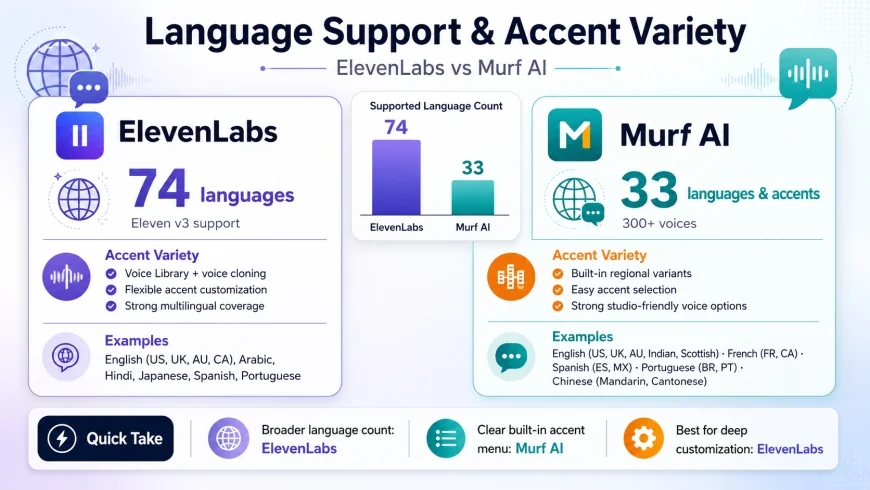 Global reach: Comparing how both tools handle regional accents and multi-language voice cloning.
Which Voice Cloning Tool Actually Sounds Human?
The answer to this depends on your definition of "human." If human means having the ability to sound tired, excited, or sarcastic, then ElevenLabs is the clear winner.
If "human" means sounding like a polished professional delivering a keynote speech without any stumbles or odd breaths, then Murf AI takes the lead. It removes the messiness of human speech in favor of clarity.
For creators looking for the best ai voice for youtube videos, ElevenLabs' ability to generate an "unscripted" feel is priceless. It saves hours of editing and makes the content significantly more engaging for the viewer.
In contrast, if you are building an interactive voice response (IVR) system or a medical training guide, Murf AI’s stability ensures that the user isn't distracted by an overly emotional or "breathy" AI voice.
Who should use what?
Individual creators, fiction authors, and indie game developers will find ElevenLabs' generative power more aligned with their creative needs. Corporate trainers, HR departments, and marketing agencies will likely prefer the controlled environment of Murf AI.
Recommended Choices by Purpose
For Narratives and Immersion: ElevenLabs is the industry standard for realistic ai voice generator comparison due to its emotional depth and speech-to-speech capabilities.
For Professional Consistency: Murf AI is the superior choice for high-volume, standardized corporate audio where precision is more important than performance art.
For Developers: ElevenLabs offers better API documentation and latency performance for integration into modern software stacks.
Frequently Asked Questions
Can I use ElevenLabs for commercial projects?
Yes, but it depends on your subscription tier. According to the ElevenLabs Terms of Service, commercial rights are typically granted on paid plans. Always check your specific plan for the "Commercial Use" badge.
Is Murf AI better than ElevenLabs for beginners?
Murf AI is often considered more "user-friendly" for those who are used to video editing software, as it uses a familiar timeline layout. ElevenLabs is simpler to start (just type and click), but mastering its "Stability" and "Clarity" sliders takes some practice.
What is Speech-to-Speech synthesis?
This is a feature—primarily championed by ElevenLabs—that allows you to use a vocal recording as a "template." The AI adopts your pacing, emotion, and emphasis but uses the cloned voice's timbre. It is the best way to get a specific performance out of an AI.
How do I avoid the "robotic" sound in AI voices?
The key is to provide context. Avoid short, choppy sentences. Both ElevenLabs and Murf AI perform better when they have a full paragraph to analyze, as it allows their neural networks to understand the flow and prosody of the text.
Are these tools ethical to use?
Both companies follow strict safety guidelines. ElevenLabs and Murf AI have protocols to ensure that users have the right to the voices they are cloning. It is recommended to follow SAG-AFTRA guidelines when using AI for professional voice-over work.
Practical Checklist for Your Next Project
- Verify commercial usage rights for cloned voices in your specific subscription tier.
- Test a 60-second high-quality clean audio sample (no background noise) for the best cloning results.
- Evaluate emotional range in paragraph-long renders rather than single sentences to check for prosody.
- Check multi-language consistency if you plan to launch your project for a global audience.
- Review API documentation for automated workflows if you intend to scale production.
- Listen for "vocal fry" or artifacts in high-intensity segments and adjust settings accordingly.